Saturday, 19 July 2008

Speed Racer (dir. Wachowskis, USA, 2008)


Why did the critics bestow upon Speed Racer such scathing reviews? Why did they cast such snooty dismissal on the only thing of worth that the Wachowski Bros. have produced since The Matrix? When I endeavoured to find the answer to this question, it lead me to straight to the answer, not to mention a point of hilarious irony. You see, the majority of critics that disliked Speed Racer gave a glowing appraisal to the mind-numbingly average Cloverfield, despite complaining that the former feature gave them... a headache... Hang on?

I felt nauseous during Cloverfield but not so during Speed Racer, but hey, that's just me. You can't account for the unpredictability of critics. Or should that read: grumpy old men critics? It seems that sumptuous visuals with an underlying warmth of heart only work in Pixar films such as Ratatouille and Finding Nemo, whereas elsewhere they are laid under the magnifying scope and heavily scrutinised. I felt fine with what Speed Racer served up to me; it was a suitably friendly tale of guarding your own integrity against the evils of selling out to the corporations, maaan. This was filtered through a familial lens as the likes of Speed himself Emile Hirsch, John Goodman, Susan Sarandon and Christina Ricci co-existed as a strong unit throughout - the only point of irritation being the obligatory annoying younger brother and his pet monkey.

It would be a shame to dwell on what didn't work for the cynical old men (or how they didn't get what they want), but what of the children? After all, this appears on the surface to be one for the
sprogs, and one would not be incorrect in that assumption. As far as youngsters go, the undeniable flaws include the runtime (well over 2 hours), repetition of techniques (broadcasters fly across the screen constantly) and the over-complicated mechanics of corporate evil. When Roger Allam - looking, sounding scarily like David Mitchell in mid-rant - burst into his third monologue in a row on where Speed Racer's interests should truly lie, I'll confess it went completely over my head.

One could count the problems on their fingers, but they wouldn't get past one hand. There's a wealth of enjoyment to be had with this one, and its flaws are easily subsided by frequent action and racing madness that literally feels like you're being raped in the eyes with skittles. The races are squeaky-clean delicious, and one fight scene in particular was bursting with such creativity and innovation that my eyes widened as if to utter the title of Pavement's third album. ;)

When I left the cinema, well, I felt like I'd watched something innocent and charming; something that took my mind off the wrongs in the world. It was a nice-looking film without a debased morality. It was a head-warmer, not a headache.

***

Saturday, 21 June 2008

How Bad Is Heroes?


That is the question.

Little under a year ago, after hearing enormous Lost-levels of hype and excitement directed towards this new show entitled "Heroes", I decided it was best to wait until the first season had finished being broadcast on television before I whizzed through it without interruption. I eventually viewed the entirety of Season 1 in little under two weeks, and found it to be hugely inferior to Lost in all aspects of character, depth and pacing. Still, I didn't write it off as a total loss, and I accepted that it was a decent enough standalone tale, a sort of 16 hour movie that had no need to continue due to its cast of characters finding resolution in their individual quests. All was tied together nicely; yes, the villain got away, but above all it seemed that there was nowhere left to go for our heroes, nor did it seem there was anything readily planned for their future behind the scenes.

This brings me to Season 2, which I finished last night. To put it bluntly, this was a total chore to endure, start to finish. So much of a chore, in fact, that I had it on the background for the majority of the time whilst I surfed the internet. I'd be reading the latest record review and I'd be offput by the ever-lasting meolodramatic wails emitting from my speakers. The flaws in the first season are amplified tenfold; firstly, there are new characters, all of them completely worthless and unrelated to the larger picture.


Rubbish character is kidnapped: the world fails to care.


Nicki/Jessica was a character I was never fond of, because she never fulfilled any purpose in the first season, other than punch people in the face when she got really angry. However, the new faces here just take the piss; we're introduced to Micah's cousin, a young black girl that works in McDonalds, but has --OMG-- the ability to replicate any action she witnesses. If she sees someone swing round a pole and kick someone in the face, she'll do it. So it's a pity when we see her newfound ability take a backseat to her incessant moping around, whining about her future.
I DON'T CARE ABOUT YOUR LIFE.
Go to acting school, bitch.
We also have two fugitives named Maya and Alejandro Herrera, even more needless. I'll get to those two later, because they have the most (unintentionally) funny scenes in the entire show.


This scene falls flat on its face from the off, mainly because there's no realistic chance that a 12 year old boy would read a comic entitled "Saint Joan"


Trash Flavoured Trash

When watching television, I almost never give it the same criticism I would impart to a piece of film. It's a whole different animal; we get fed so much bullshit in the form of reality TV, game shows and cheesy soap operas that's it become commonplace to accept television as the shameful home of trash. It is a form of escape distant from that of cinema, where we easily submit to dumbed down productions such as Strictly Come Dancing, Britain's Got Talent, amongst other countless moronic cesspools of shit that clog up the Saturday night schedule. I've largely given up on television, aside from a few gems that strive to remind us that there does indeed exist a niche of well-written, well-constructed dramas. I'll admit most of these come from HBO, namely Deadwood, The Sopranos and The Wire, but there's also some worthwhile, intelligent comedies like Futurama and South Park; shows that opt to entertain, rather than patronise their audience.

With Lost, I'm in the mind that it's brilliantly crafted, but poorly written. Watching shows like Deadwood really do reinforce this fact. But Lost is a gimmick show, and it aims for different goals than those from the HBO stable. I can't judge Lost like I would a film, I don't want to fault it; it keeps me guessing, and I respect any show that encourages thoughtful guesswork in its viewers. The same can't be said of Heroes. Not only do I care little in anticipating the endeavours of its many, many unnecessary characters, I also can't help but watch it with a critical eye. It does so much to rub me the wrong way, that I happen to notice every annoying camera movement, every hint of grating melodrama, every unintentionally hilarious moment - of which there are dozens, might I add.


This girl has the ability to heal herself, yet she's still crying? Ungrateful cunt.


The camera mostly sits below the characters, making them seem bigger and more prominent, like...heroes, I guess. When something OMFG occurs, the camera will then swoop straight into their agonised faces whilst we're forced to listen to them talk to their family in a way no real-life family converses with one another. What kind of world are they living in where a mysterious boy can enter the family home at early morning and make waffles with the mother, despite them having never met before? Why is Claire so emotionally open with her father, Noah? Have they had sex? Why has Peter Petrelli reduced his persona to that of Anakin Skywalker, walking round with an ingrained scowl, talking like a man squeezing out a cold, hard shit?


Peter Petrelli channelling the thespian talents of Hayden Christensen.


A key strength of Lost is the unpredictability of the island itself. There's always an impending sense of doom, a reminder that the environment is consistently dangerous. Any cast member could be killed off at any point, without warning, without remorse. Heroes, on the other hand, hates to take risks with its characters. It's remarkable that a show has presented its characters with no depth of interest, yet at the same time is scared to rid itself of them. The creators love their characters so much that any time one happens to be ceremoniously killed off, you can expect them to find some cheap trick to bring them back almost instantly. My favourite one is the regenerative cell skillz - it's an ability whereby the host can bring their limbs back to full health, no matter how much damage it's taken. Noah Bennett gets shot in the eye, dies. No wait, he's alive~! Oh, but...Adam Monroe has just got a sword through the chest...looks like he's...no, oh my, he too is seemingly immortal!


This poor soul's just been told he can't leave the show and return to his family, because
NO ONE MUST DIE.


Foolish Mortals

My last complaint is of the jaw-droppingly absurd variety. Sylar, the villain of Season 1, is another fella that got completely merked by the good guys, yet somehow managed to survive and fall down a drain, causing him to end up in Mexico by the time Season 2 rolls around. Whatever. He happens to meet the horribly unnecessary Maya and Alejandro, as I mentioned before, and decides to hitchhike with them. Discovering they have the ridiculous ability to make people's eyes bleed, he decides to trick them into taking him somewhere where yadda yadda yadda. Before I continue, I must state that this trip in the car takes up ELEVEN EPISODES.

The best, most laughable part of this scenario is the complete willingness of Maya to surrender herself to Sylar (going under his guise of Gabriel), no matter how sinister he acts around her. When they first meet and exchange introductions, she tells him he is their saviour, because he is named Gabriel, 'like the angel'. Sylar then looks out of the window, adopts a mighty evil grin, and murmurs in a highly suspicious tone of voice, 'Yes...like the angel...' Look, I'm sorry, but if I was in that car with him, I sure as hell wouldn't respond with an admiring gaze. I'd boot him out! No, Maya treats him like a demi-god...only it gets worse, read on.


"Yes...like the angel...mwahahhahahaaa."

Sylar makes it perfectly clear he's one evil sonofabitch. Meanwhile, Maya looks on as if she's always wanted a serial killer for Christmas.


Alejandro is a bit of a wise guy you see, since he cottons on that Sylar, or Gabriel, has no such good intentions and is actually plotting to kill them both. Actually, Sylar tells him this straight up, just to rub it in, y'know, a 'I'm gonna kill you, then screw your sister in the ass' kind of way. Why Sylar feels the need to wait through eleven episodes of car-pooling to carry out this deed is really beyond me. Countless scenes go by of Sylar saying blatantly evil things, even so far as suggesting that Alejandro be left behind to allow him and Maya some alone time (not a good idea), until we reach the eventual murder of Alejandro.


Sylar, again, taking great pains to remind us that he's evil. Strange how he only seems to do this when Maya is standing right next to him...


This is where the whole ordeal reaches new levels of comedic brilliance. Before Alejandro is killed, he takes Maya aside and shows her a newspaper article about Sylar's reputation as a serial killer, complete with an actual picture of his face on the front page...


...only Maya still doesn't believe the good authority of a broadsheet, and instead professes her love to Sylar/Gabriel, who is stood outside Alejandro's cabin, Sylar currently topless and sweating after having exhausted his energy murdering Alejandro, the butchered brother generating screams of pain that Maya was clearly in earshot of. Selective hearing is a bitch sometimes, isn't it?

To cut a long story short, the naive Maya is eventually shot by Sylar, not long after a complete stranger (a small girl who has spent the entire series stuck in a room and hasn't seen any of the aforementioned events) has to be the one to tell her that Sylar had murdered her brother.


Maya, watching on with a permanent smirk as Sylar, on the phone, more or less implies murdering a 5 year old girl......


...and here, Maya gets completely owned by said 5 year old girl, of superior intelligence.


I can't deal with Heroes anymore. It makes my blood boil, it drives me to cynicism of a violent nature. It makes me cringe. It goes without saying that I won't stick around for Season 3, unless the show's writers do the impossible and gleefully massacre all their characters. It's a shame that won't happen, because Heroes is afraid to take risks in all areas of its execution. If this year brings more of the same, then I won't be taking a risk with it.

I think I'll stick with Lost, 24 - what I like to call 'good trash'.

Thursday, 12 June 2008

The Four Star System

I've come to realise that marking movies out of 10 is futile. Below five, which of course stands for "average", are a multitude of numbers and their increments that prove too much in determining just how poorly a film has missed the mark. I concede that above five, there are plenty of helpful stepping stones towards the full mark in which to place a film in reflection of its quality, but when it comes to a film I generally dislike, finding the correct number below 5 is more often guesswork than it is an assured judgement. So I've come up with, or rather, adopted, the four star system; increments, warts 'n' all.

As well as providing less numbers for easier classification, the four star system also allows me to award the full mark of four to films I admire without carrying the hyperbole that one would associate with "five stars" or 10/10. The system also helps me avoid unintentionally ranking in order a select group of films belonging to the canon of a director or genre; this ranking you would ordinarily find in the carefully placed decimal points of a 10-mark system.

Here's how we work:

**** - Excellence. Must-see. Hells Yeah.
***1/2 - Pretty freakin' awesome. Near-perfect. Damn fine.
*** - Swell. Good. Check it, y'all.
**1/2 - Above-average. Ok. Worth a look.
** - Mediocre. Middle of the road. Just tolerable.
*1/2 - Heavily flawed. Unmemorable. Best avoided.
* - Really bad. Flaw-riddled. At its best, terrible.
1/2* - Just awful. Unwatchable. Disgusting.

I'll avoid the "no stars" rating because as aforementioned, there's only so many ways to rate a bad film. The 1/2* is awarded to those films at the very bottom of the barrel; excrement like Pirates of the Carribean 3, Outlaw, Doomsday and The Accidental Husband. To put into perspective just how the four star system relates to the 10/10 system, here's a helper:

**** = high 9 - 10
***1/2 = high 8 - low 9
*** = high 7 - low 8
**1/2 = high 6 - low 7
** = high 5 - low 6
*1/2 = 4 - low 5
* = 2 - 3
1/2* = 0 - 1

I'll go back and convert previous ratings according to this system, and all future ratings will be out of four stars. Oh, and I promise the Top Movies of 2007 list is coming soon.

Thursday, 29 May 2008

Son of Rambow, Forgetting Sarah Marshall, Joy Division, Smart People, Iron Man


There's a couple of films I really want to talk about in depth, but before I go into those, I thought it'd be best to brush a few others aside. I'm going to briefly touch on the movies listed in the post title, with individual verdicts. Awesome.

So the first of these is Son of Rambow (2008, UK, dir. Garth Jennings), a nostalgic coming-of-age tale set in the English countryside of the 1980s around the release of First Blood. The film is essentially a retelling of Jennings' own experience recreating the first Rambo feature with his friends, complete with inventive set-pieces all captured on home video. There's a good deal of slapstick and a sense of adventure as the loudmouth schoolboy Lee takes Will under his wing and sets about creating his own amateur mini-masterpiece, generating a warm friendship along the way. There's a distinct charm to Son of Rambow that wasn't present in the similar Be Kind, Rewind, released earlier this year. Whereas that film relied too heavily on Jack Black's buffoonish antics to carry itself to the Capra-on-acid conclusion, Son of Rambow chooses to mix a blend of childhood laughs and drama for a contemplative feel.

However, the two varying tones don't mesh together completely well. In fact, the serious nature - and indeed moral - of the story only fully joins with the comedy in the last 10 minutes, and up until then they're presented in differing measures that don't exactly balance out well. Throw in a subplot about a French exchange student that's extremely ill-judged and irrelevant, and this pleasant lil indie flick falls short of greatness.

**1/2

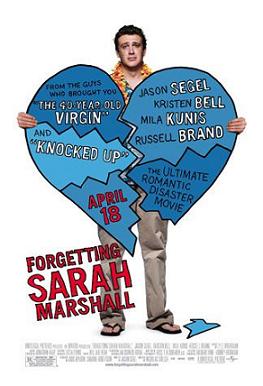
Next up is Forgetting Sarah Marshall (2008, USA, dir. Nicholas Stoller), the latest offering from the Apatow troupe, whom I have been quick to praise on the basis of their recent efforts, such as Knocked Up, Superbad and Walk Hard: The Dewey Cox Story. Here we have Jason Segel playing a character he wrote, yet another hopeless middle-aged slacker beset with girl problems. Sounding familiar?

To cut a long story short, Peter Bretter (played by Segel) is dumped by his actress girlfriend (Kristen Bell), and proceeds to wallow in depression and one night stands, until his step-brother (played by the consistently funny Bill Hader) suggests that he take a well-deserved vacation. Peter heads to Hawaii but oh noes~! Sarah is there with her new boyfriend: one Mr. Russell Brand.

Now I'm not the biggest fan of Russell Brand. In fact, on a good day I don't find him funny at all. He's a very charismatic and quick-thinking comedian, but not all he throws at the wall sticks terribly well. Having said that, he is honestly the best part of this film, and he's really just being himself. It's amazing, and the same goes for Bill Hader, Paul Rudd and Jonah Hill. The supporting actors, with minimal screentime, steal the show and really show up the main cast.

In Knocked Up, the pigheadness of Seth Rogen's character actually helped lift the film above your typical rom-com fare, adding an edge to proceedings and creating a little admiration for a person we should automatically dislike from the get-go. In Forgetting Sarah Marshall, Segel's character is so pathetic and whiny that it's hard to spend time with him over the course of 120 minutes.

The structure of the film is complete mess; once the one-joke gag is set in place, the story devolves into a series of overlong episodic occurences that further drive Segel into depression, thus furthering our despair at his irritable, helpless personality. In a film such as this, we need to be on the protagonist's side in his quest for the girl(s), but in all honesty, I just wanted to see Russell Brand own this sucker. When Brand packs up and leaves a fair bit from the end of the movie, I felt like there was nothing left to stay for. Another scene with Bill Hader, maybe?

The biggest crime committed by Forgetting Sarah Marshall is its utter lack of laughs. There's so few funny moments that you forget it's supposed to be a comedy, and therein lies the ultimate sin: a comedy that isn't funny. Forgetting Sarah Marshall is a failure, and it left me leaving the cinema feeling pretty downtrodden. Should a comedy do that?

*1/2

Keeping with uplifting cinema, we look at Joy Division (2008, UK, dir. Grant Gee), a well-crafted documentary look at the seminal 1970s post-punk band. If you're not a Joy Division fan, this may do little to keep your attention. If you are a fan, a big fan, it's hard to estimate whether you can take something away from this.

I loved last year's Control, placing it high up in my Top Movies of 2007 list (coming soon, by the way). However, it was obviously a film centred firmly around the illness and impending suicide of Ian Curtis more than the band itself. With this new documentary, Grant Gee helps to fill in the blanks left by Control, and invites the remaining members of the band, nowadays known as New Order, to give a retrospective look at their time spent as Joy Division.

There's plenty of amusing tales to hear, loads of archive footage to sink your teeth into. It's an altogether well-made, well-researched piece of work. The major problem is that I'm unsure that for big Joy Division fans, whilst the film offers a nostalgic, elegaic reflection on the band's short-lived existence, it doesn't really say anything new. Amongst the tidbits and musical performances that fill the runtime, one must leave the screening as I did and wonder what exactly was learned. Are we merely looking back through a photo album?

**

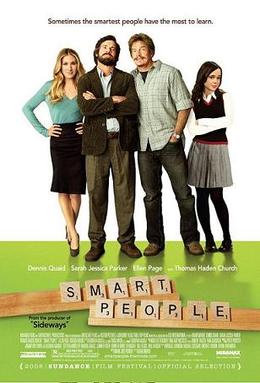
Here's another depressing piece of trash. Smart People (2008, USA, dir. Noam Murro) follows a dysfunctional family as they fail to communicate effectively with the outside world, each other, and most importantly, us. Aside from Thomas Haden Church, playing the slacker character he nailed so well in Sideways, every character is toally unlikeable, following unsympathic plights that when they finally reach a resolution, mean nothing. The whole thing is just heinously uninvolving.


Ellen Page grates too easily, Dennis Quaid spends most of the movie mumbling incoherently, and Ashton Holmes is so underdeveloped as the quiet older brother that the only line I even remember him saying in the film was "Shut up", directed at Ellen Page. Bravo, Ashton. I probably felt more depressed coming out of Forgetting Sarah Marshall, but I definitely left Smart People feeling deflated, like the film had nothing to offer and I took nothing away from it.

There was a message in Smart People, but I didn't want to find it, because the whole thing was so detached from its audience. It reeked of self-importance and, in a fitting sense, pretended to be more smart than it was. It should have been called Miserable People. It should have been called People That Chat Balls Whilst An Indie Guitar Strum Kicks In At The End Of Every Scene, Followed By Some Douche Singing About Autumn Leaves.

*
1/2


The summer blockbuster season has begun, and our first treat is Iron Man (2008, USA, dir. Jon Favreau), a fantastic origin tale of one of the most overlooked comic characters in history. Robert Downey Jr. plays Tony Stark to perfection, embodying the icon with a level of attitude that couldn't be pulled off by anyone else. There would have been no substitutes; Downey Jr. is Iron Man, he carries the entire film on his shoulders so flawlessly that it's impossible to think of anybody else in the role. Could Iron Man have fallen apart without Downey Jr. in the lead role? Probably not, but it would be half the film it is currently.

I thought Iron Man would be an average by-the-numbers origin tale. I didn't think it could match the excellence of say, Spider-man 2 or Batman Begins. Needless to say, Jon Favreau must have some amazing talent to completely surprise me with the level of quality imbued in Iron Man. It has action, suspense and explosions; yes, all the key ingredients of your summer blockbuster, but it's also really, really funny. The light humour that fills the movie, partly down to the chemistry between Downey Jr., his robots and Gwyneth Paltrow, signifies a larger accessibility to the heart of Tony Stark's persona than the emo-stylings of Peter Parker, or the brooding angst of Bruce Wayne. Stark is a millionaire playboy, one that asks for a cheeseburger first thing after fighting his way out of a hostage situation, so he's pretty chillaxed.

The action doesn't disappoint, mostly because Favreau has the same line of thought as me when it comes to CGI. He isn't keen on the stuff, so he opted to make the action sequences in the movie seem as photo-real as possible. The sight of two iron suits fighting seemed relatively realistic, gleaming with a polished look that made the combat altogether nice to look at. Believe it or not, you could actually see the robots fighting in this one. I'm looking at you, Michael Bay.

Jeff Bridges looks permanently dodgy throughout that it's a wonder they didn't pre-emptively lock him away in the opening minutes. His villainous alter ego, the Iron Monger, is a worthy opponent for a rookie such as Tony Stark. While some were disappointed by the final confrontation between these two, I was left satisfied; I felt that it was a fair match for an origin tale, leaving a much bigger, badder villain to emerge in the sequels...possibly the Mandarin, or even the Hulk.

Villains aside, this was an extremely pleasing superhero origin story, helped along most significantly by the central performances from Downey Jr., Paltrow, Howard and Bridges. I can only hope the chemistry between these actors continues to sparkle into the next few films in the franchise, and that Stark's eventual lapse into alcoholism won't bring about too dark a tone that the series will lose its way. For now at least, I deem Iron Man to be a highly promising franchise.

***1/2

As well as my Top Movies of 2007 to come, I'm set to give my verdict on other recent summer blockbusters: Speed Racer and Indiana Jones and the blah blah blah. On top of that, Doomsday and Funny Games U.S. will get a score out of 10, and I'll leave you to guess which one I loved, and which one I hated.

Monday, 19 May 2008

Shine A Light (USA, 2008, dir. Martin Scorsese)


It seems that biopics and musical documentaries are slowly becoming Scorsese's things as of late, the former represented by The Aviator and the rumoured upcoming Sinatra flick; the latter comprised of the 2005 Dylan picture No Direction Home, the also rumoured Bob Marley doc, and of course, Shine A Light. The Departed was Marty's rightful farewell to the mobster genre that he had so skilfully mastered over the years, leaving room for the venerated filmmaker to express his passion for music once more. Next up: The Rolling Stones.

For those who argue that Marty's talents are better employed making fictional feature films as opposed to music docs and concert films (an opinion belonging to my lecturer, who wasn't impressed by SAL, if you must know), the output doesn't prove them to be correct, nor does it condemn their wish for Scorsese to stick to the thrillers and gangster flicks they revere him for. Shine A Light will not please everyone (it won't convert non-Stones fans), though if you're into the music, and you're out to have a good time, it won't disappoint.

For those wondering whether this concert flick matches, or supersedes, the quality of 1978's The Last Waltz, I'll tell you now: it sure as hell doesn't. Although, for what it attempts, it very nearly succeeds to the best of its efforts. After all, Shine A Light has all the ingredients: the music, cinematography and onstage personalities all do good in carrying the film to its rockin' curtain call. The flaws that hold it back should be as evident as daylight, or to put it more bluntly, as evident as the deep wrinkles adorning the saggy, decrepit face of Keith Richards. Sorry, I had to go there.

The Rolling Stones do indeed look like animated corpses bouncing around on stage. Mick Jagger at least maintains his trademark swagger, strutting up and down the makeshift catwalk with confidence whilst the remaining members of the band do their thing in the background, drowned out by the sheer presence of their frontman. The camera stays on Jagger for the majority of the runtime, with second place going to Richards... and I don't even remember catching sight of Charlie Watts.

To combat the ghastly sight of The Rolling Stones looking like mouldy fruit, the filmmakers have cunningly decided to plant stupidly hot young females in the front row, just in case, y'know, we want to touch ourselves in the cinema. In all seriousness, I appreciate the sentiment, but putting actual Stones fans in the right places might have been an effective way to showcase an intimate communication between the band and their fans, instead of having to put up with a legion of clueless blonde girls feigning a sing-a-long mere inches away from Jagger's feet.

The placement of these 'fans' is the only significant qualm I have with Shine A Light, as the majority of the film is packed to breaking point with what you pay your money for: an expertly filmed concert featuring the very best of the Rolling Stones back catalogue. Some songs hit harder than others, particularly with the big songs popping up at the beginning (Jumpin' Jack Flash, Shattered) and end (Satisfaction, Start Me Up) of the set, though the middle space is occupied appropriately by collaborations with the likes of Jack White, Christina Aguilera and Buddy Guy, ensuring your attention never wavers.

All this is captured with some dazzling cinematography by a whole host of contributors, perfectly keeping up with the charismatic to-ing and fro-ing of Jagger; infusing the screen with as much colour as the exuberant tunes of the Stones.

The concert footage is intercut with archive footage of the musicians in their youth, consistently stating their ambitions for the band that always seem to revolve around how long they'll last. Well, they've lasted a hell of a long time, and in that respect, Shine A Light seems as though it has something to prove for the band.

Maybe it has something to prove for Scorsese, that he can still shoot a concert film to the best of his abilities. It isn't perfect, but so what? For the most part, Shine A Light does what it says on the tin, and delivers on its promises. And really, do most films these days succeed so admirably?

***

Thursday, 8 May 2008

The Red Album

I love Weezer. They try my patience, but I bloody love them.

The crushing truth of the matter is that they haven't produced anything worth a damn in the last 10 years. Which is upsetting because The Blue Album and Pinkerton are easily two of the best albums of the '90s, and the soundtrack from better days in regards to yours truly. The Green Album has its moments but is far removed from the Weezer of old, Maladroit is unfortunately sending the band headfirst into guitar-pop hellfire and the less said about Make Believe, the better.

"We are all on druuugs".....*shudder*

I was informed tonight that the much anticipated (?) Red Album, due out in June of this year, had 8 of its tracks recently leaked onto the internet. I took a sneaky listen, though I swear I'll either delete it if I don't like it, or pay for it if I do. I promise. It's Weezer.


1. Troublemaker - Yeah, this is a good opener. It doesn't exactly signify that this album will be an immediate return to form for the band, but it starts the proceedings off optimistically. Although, I'm a little uneasy at Rivers rhyming the words "beeyatch" and "keeyads".

2. The Greatest Man That Ever Lived - WOW. This is easily the best track on the album so far. It's more complex than Weezer have allowed themselves to ever be, and it works. There are a lot of different parts, from the Isaac Brock-sounding opening lyrics, to the finishing rush of guitars that seem so reminiscent of early Weezer. A great, great song.

3. Pork and Beans - This was the first track that anyone heard from this album, and it generally pleased fans and critics alike, some saying it was a sign of a return to form. I'll agree; it's a catchy, feelgood anthem, without sounding like something that would belong on Maladroit. It seems almost Pinkerton...

4. Heart Songs - River gets emotional on our asses, and I'm not entirely sold. It starts off sounding like an R'n'B song, before building up into a climax that utilises a guitar melody I'm positive they've used before on a Blue Album song. I just can't remember which one. I don't dislike this song, it just hasn't grown on me yet. I'm not sure it will.

5. Everybody Get Dangerous - Uh, what. This is one of the worst Weezer songs I've ever heard. The title is basically the chorus, basically sung on repeat over a three chord riff that wouldn't seem out of place on the soundtrack of a racing game. Oh, what's that? It features on the new Gran Turismo game? Fucking hell. Things were going so well, too.

6. Dreamin' - Fluffy, poppy anthem here. I didn't like it at first, but on repeat listens I notice that at a five-minute runtime, I actually like more than half of it. It does get better as it progresses, I'll give it that. It still hasn't got the sour taste of Everybody Get Dangerous out of my mouth, but I think we're getting there. Decent song, and I dig the last part.

7. Thought I Knew - Who's this singing? It ain't Rivers, but what the hey time for a bit of a mix up. Not a bad song, not a good song. Sort of middle of the road, but it might just grow on me more so than Heart Songs. I could give it a thumbs up for now.

8. Cold Dark World - I actually really like this one. It's a slow-burner, but it's also quite a dark treat on an otherwise so-far so-chummy LP. Thumbs up? Yeah, go for it.


So...out of the 8 tracks so far we have three very impressive opening tracks, along with two decent tracks, two semi-decent tracks and one simply atrocious song that I will never, ever warm to. Now, there's two extra tracks due for the official release, plus four bonus tracks. I'm a little worried about quantity superseding quality here, but alas my fears of this being Make Believe Pt. 2 have been proven fatally misjudged.

It's definitely not a return to form as I would have hoped, though on the basis of the first three tracks, I know Weezer can still pull out a tune or two and fingers crossed the closing tracks may just rescue the whole thing. It'll probably end up slotting underneath Pinkerton and above Green. Weezer are hanging on by a very small thread, but oh man, do I love 'em.

Saturday, 26 April 2008

In Bruges (McDonagh, Ireland, 2008)

Let me start by saying that In Bruges is the best film of 2008 so far. At least, from the batch of films I've seen from the past four months, this dark picture easily takes the lead. If you know what I've seen, it isn't hard. In Bruges certainly doesn't achieve this accolade by default; rather, its achievements are many, coming across as both a black comedy and a very human drama.

Colin Farrell and Brendan Gleeson star as two hitmen, Ray and Ken, that travel to Bruges for reasons unknown. Something bad happened back home, and the boys are taking a much needed vacation on the orders of their boss, Harry, played by Ralph Fiennes. The events that unfold from the opening to closing credits depend solely on the actions of each character, all three driven by their own distinguishable ethics and morals.

From the moment Fiennes is introduced fairly late on, he portrays the mob boss with a visceral ferocity, but it's Farrell, and in particular the on form Gleeson, that entertain most with the ease in which they play off one another. In travelling through Bruges, they adopt a father and son relationship that never feels false; Farrell constantly retreating to a worried, huddled sit-down on the nearest bench, or nipping off to the pub at the most impromptu time, whilst Gleeson does the 'old man' schtick of savouring the sights of Bruges.

Bruges looks spectacular, and acts as a remarkably colourful backdrop to the film, but it's the equally colourful characters that really drive it towards its conclusion. They feel authentic, as if acting on their own voice instead of a script. It's great that Farrell got this role, one that he seems comfortable in portraying. I'm not the biggest Colin Farrell film, but In Bruges does well to showcase the talent I believe he does possess; a far greater role than those he played in The New World and Miami Vice, despite both these films being significantly stronger than In Bruges.

Not content with letting Bruges be our eye candy, McDonagh lays on some striking musical pieces to accompany some of the film's more darker glimpses, fusing well with the images to create some truly tense, gripping moments. It is a dark film, no matter how the poster may mislead you; the marketing campaign seems to have gone for the all-out comedy approach, but there's a lot of grit beneath the surface of the film, especially once we hear Fienne's voice for the first time, thus realising the implications. That's not to say In Bruges is without its funny moments; it's littered with as much swear words and midget jokes to satisfy those that did admittedly show up for a few shameless laughs. Placing it in the comedy genre, however, does not do its merits justice, nor does calling it a British gangster movie. We're not on Guy Ritchie levels of superficiality here.

There is a recurring theme throughout In Bruges of the child, as first evidenced in the father/son exchanges between Ray and Ken. Without spoiling how this theme carries on into the remainder of the movie, I'll just say that it had me second-guessing the actions, motives if you will, of particular characters in the final minutes. While what happened completely took me by surprise, in the end I couldn't quite work out whether McDonagh had completely missed a shining thematic opportunity, or if the characters themselves had ran purely on their ethics (perhaps blindly), as I alluded to before. Either way, it still works; the final act of In Bruges easily supersedes the previous ninety or so minutes, utilising gorgeous visuals and haunting musical scores for maximum effect, an excellent execution.

Fock'n see it.

***