Wednesday, 20 May 2009

Encounters at the End of the World (2008, dir. Werner Herzog)


Herzog treats the subjects of his latest documentary in a peculiar fashion. One eccentric man is left to stand in front of the camera long after he's finished his diatribe about having descended from an Aztec King. Another man is cut off in his ramblings by a narration that interjects "to cut a long story short..." When these moments occurred, the audience around me laughed. I chuckled too. They were peculiar folk, after all; I imagine Herzog was being playful in his emphasis on their odd personalities. Then again, images do speak for themselves - what to think of a woman who traps herself in a luggage bag every night on stage?

Who are these people, exactly? They're just a handful of individuals who, as one interviewee puts it, "have each fallen down into the end of the world", that being Antarctica. A philosopher is now driving a forklift, a filmmaker is now serving up ice cream in the cafeteria, and an intelligent young man with a PHD in Linguistics is now keeping his eye on some plants. They're talented in their own field, yet they've somehow found themselves in this place, aiding a great scientific discovery. They've formed a new society, away from society itself. I'd say they deserve their segments.

But shining the spotlight on these individuals, operating within the confines of their immense scientifc compound, is just part of the bigger picture that Herzog is painting. We're in Antarctica to view nature at its most underestimated and unpredictable. It's not long after we've seen the stuffiness of the complex, and the unpleasant sea of mud that surrounds it, that we're thrust into the great white open.

When explorers first came across Antarctica, they assumed for the most part that the icebergs were one big static monster. They aren't, of course - they're constantly moving, at an alarming rate. We know this now - science has aided us in discovering much about the past and present, but the future is unwritten. What will happen to these icebergs can only be assumed, and the speed in which they change is on our hands.

So, is this a film about climate change? No, I wouldn't say so. To assume this would be awfully reductive, ignoring some of the larger considerations at hand. Herzog has always been fascinated with nature, be it his confusion over man's lust for fire or the disinterested stare of a grizzly bear. Nature presents itself in simpler ways here; we look at many beautiful creatures crawling along the seabed, discover new species after a day's worth of diving, celebrate said discovery with a jamming session on a barn roof.

These underwater excursions are shot with swooping (tracking, floating?) shots that glide across oysters, jellyfish and other such wonders of nature, joined with searing opera scores that would lift these sequences to the heights of Herzog's own Lessons of Darkness, if it wasn't for the shakiness of the camera disturbing the flow only slightly. This is but a minor quibble, and the images on show are nonetheless remarkable in their purity.

What sets this apart from other documentaries of its kind are the worries it raises; rather than simply observe the goings-on at the facility, Herzog ponders over the power of nature. Through his encounters at the end of the world - man, creature and iceberg alike - he considers our place in the grand scheme of things, of time. A collection of flowers and cards have been framed in the ice, bordered by popcorn. They are intended for future visitors: alien, perhaps?

The concept of global warming can be discussed and rejected time and again by the men in suits, but it's the problem of every living human on Earth. One thing is for sure: nature is bigger than us. We are not in control. We know very little and we underestimate even more. What could each of us say about the mental states of penguins? Or the calls of the sea lion under the icebergs? Or why a woman chooses to lock herself in a luggage bag?

On the face of it, Encounters is about the kinds of people that yearn further knowledge of the Earth they inhabit. They want to understand more. Unusual characters they may be, but that is what fascinates Herzog and his audience; we were okay to laugh. The nature of man is as intriguing and amusing as that of the penguin and the sirens beneath the icecap.

If I were to talk with these scientists, they would tell me that it's only a matter of time before nature wipes out mankind, and we go the way of the dinosaurs, lost in time. If I was to speak to a Creationist, I would be told that Armageddon is coming, complete with locusts and four horsemen.

Either way, I'm left feeling fairly insignificant.


8

Sunday, 3 May 2009

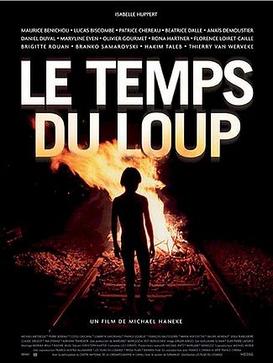
Time of the Wolf (2003, dir. Michael Haneke)


"For everyone in the West, the end of the world is something that they witness from afar, on their television screens, in the safety of their living rooms. I wanted to bring the end of the world to those people."


Michael Haneke says this in a special feature found on the Time of the Wolf DVD, sat smugly, stroking his wispy white beard. The man is smug, it has to be said. Who else would direct a film like Funny Games not once but twice, displaying such contempt for their audience? Haneke does like to test us, to make us ask questions of the film and our own predicaments. Don't most good filmmakers? Looking through his various works, each has a rather humanistic element, be it Cache with its examination of guilt, or the study of communication throughout Time of the Wolf. Haneke is fascinated by the ways in which we speak with each other and ourselves. I delve into Le Temps du Loup, engaged and ready to ask questions as I go; communication is essential...


The boy has been found. What was he doing, out here in the dark? If you witnessed the murder of a loved one, there's no place you'd rather be. Humanity does have a habit of finding itself within the darkness; how we could even begin to search for ourselves in the daylight, no one knows. He's silent, he will remain so for a while. His companion is taller, hesitant, dressed for the cold of winter. He stands at a distance from the rest, fearing their touch. Change isn't preferable.

Onwards they go, heading nowhere fast. They go through trees and fields and train tracks, all empty. They might find a train, might even be on a train at some point. But where will that train lead? What hope can you place on a destination unknown?

And people... more people, arguing over water. Arguing over everything and nothing. Horses are shot, goats have their throats slit. This is life, only smaller; we're in a microcosm. I'm different, and everyone else has remained the same. They're all here with me. Do I know you? He looks different, she is anxious. I saw them earlier, committing a mortal sin, but there is nothing to be done about it here. Evil walks the earth, what little precipice we huddle together on... and it's crumbling. Helpless and waiting for the end.

The screams are agony, the lights in the distance tell me of something sinister. I choose to talk to he who is no longer with us, who will not respond, who can not help any of us. But still he watches.

Kids are the future, aren't they? The small one lights a fire. Could he be one of thirty-six? A Just? A man stops him just in time, cradles him. The camera delicately pulls itself back, leaving them alone together; this is either good or bad. There was almost a martyr for the cause, now a memory of near salvation. Smells like Tark. Has any of it gone to waste? After all, it's the thought that counts.

I'm going to show you something:

Movement - alright, we're going somewhere.

Where?

You tell me.

Why?

You tell me.

You're looking at a black mirror; clean if you wish.

8.5

X-Men Origins: Wolverine (2009, dir. Gavin Hood)


I must admit, I've been looking forward to writing up this little number, if only to clear away a few misconceptions about myself. Yes, that's right: this review is all about me. Forget the efforts of Hugh Jackman, Liev Schrieber and Gavin Hood, because Wolverine is now the launching pad with which I can put a few things straight about myself, in the context of comic book movies.

I guess the first thing to make clear is this movie sucks hard. I am better than this film. Why? Because I am a human being, made up of many complex organs that work together tirelessly to keep me alive. I have a brain with which to think and make logical decisions. I can feel emotion, such as the anger and pity I feel towards the producers of Wolverine. I listen to a wide variety of musical genres, and I'd like to think I've reached the point where my film taste is refined enough to filter out anything with the buzzwords 'Michael Bay', 'Eddie Murphy' and 'Paul Haggis'. Ok, I'll flatter myself - that moment came long, long ago.

And yet, I don't love myself. In fact, there is as much self-loathing inherent in me as there is self-admiration. I am as flawed as the next man. Still, as worthless as I could possibly be, that would still not bring me down to the utterly useless levels of Wolverine.

People say to me, "Ed, you read comic books, so surely Wolverine is your thing?" WRONG.

I read comic books, yes, but over the years I have learnt to cut down my subscription into the most essential list of books you could ever need (If anyone's interested, Green Lantern, Batman and New Avengers are rockin' right now). I do this because of two words that I've always stood by in my brief tenure as a human being: QUALITY CONTROL.

I won't stand for mediocrity, and I demand that my music be brimming with passion, creativity and originality; my films must challenge, speak to me or at the very least entertain me; my comic books must be well-written. Good artwork without good narrative? I don't think so.

You see, in the same way that a good director is behind every good film, a good comic book is written by a great writer. If Wonder Woman was written by Geoff Johns, you're damn right I'm gonna give it a look-see. Quality control, people. There is so much content out there, and so little time to take it all in.

Now I'm a fan of Wolverine and the X-Men in general (I even wear Wolverine socks), but I'm not willing to go lightly on director Gavin Hood because of this fact. To slap a brand on any piece of turd and assume that it will appeal to me is absurd. Just look at Quantum of Solace. Let us judge the film for what it is. how it is.

Onto the next misconception: "But Ed, you watch wrestling. That's just angry men fighting each other, what's so different about this?"

Wrong again, friendo. Firstly, I'd like to say that it's usually the people who have no hobbies or interests other than football that tend to call me out on my appreciation of pro wrestling. Ironic. Secondly, wrestling can be interesting when it wants to be. Put the right people in the ring, give them enough time, and they can put on a great show. They can tell a story if they want to. The bottom line is that the fixed, choreographed nature of wrestling is what makes it so great. Because these guys have their moves planned out, everything can run a lot smoother and entertainment through soft violence is achieved.

Translate this to film language, and what we're asking for are well-made sequences of plausible, enjoyable action. I'm talking about the original Die Hard, which didn't need plane-surfing, or dudes leaping from tanks onto choppers, to grab people's attention. I'm talking about the Bourne series, where the action is well edited, as opposed to Quantum of Solace, which aims to ape Bourne's style whilst forgetting to let the audience know what exactly is going on.

Does Wolverine have its merits, taking into account all these preconceptions about my judgement on what makes a good comic book film? Let's compare it to last year's offerings. Iron Man had humour and a charismatic lead in Robert Downey Jr., in addition to the chemistry he shared with the rest of the cast. With Hugh Jackman, all the man seems to feel is great anger towards everyone alive, allowing his character no development over the course of the film. He learns nothing new, forgets an awful lot, and gains more enemies than friends.

The Dark Knight gave us plenty to chew on, what with its nifty subtext about terrorism, neo-conservatism and political leaders. Does Wolverine give us equal insight, or at least some sort of theme? This is a Fox production, so you can answer that one yourself. Maybe the pleas of "you must fight the animal inside you, be good" constantly screeched towards Logan could count as a wider moral, only the very idea is counteracted by every single character in the film bashing the living shit out of each other with canes, claws and playing cards.

Hellboy II was much funnier than Iron Man, but for this one I'll draw on the set design. Big Red's playground was lusciously imagined, filled with the sort of creatures you'd expect to find in the Mos Eisley Cantina, the colourful backdrops you'd expect any other director than del Toro to lazily render with CGI. Wolverine decides to do things the Marvel way, having its production design imitate last year's Incredible Hulk by way of surrounding Wolvy with tanks and other such militaristic backdrops. Such a colourless movie.

Wolverine's girlfriend is slain in the first act - that isn't a spoiler, it's shown in the trailer - and this is supposedly the motivation for him to unleash holy hell on absolutely everyone. As he holds her limp body in the snow, we fail to care. Apparently we should, judging by the heights the score's volume reaches. Once Wolvy's journey begins, we're taken on a humourless romp through a who's who of Marvel mutants.

(Ok, I have to pause here. There is one really, really funny moment in this film. Wolverine finds shelter in the barn of an elderly couple, who out of the kindness of their hearts allow him to stay and recuperate. One bright spring morning they decide to bring him tea and biscuits - when suddenly they are both riddled with bullets and their barn is blown to smithereens by helipcopter missiles. I laughed, but I'm not as sadistic as you'd think, I just thought it was really, really bad luck!)

Gambit, Deadpool, Blob... they're all here, mismanaged in one way or another. It's almost like Epic Movie; they show up to satisfy whichever kid in the audience finds solace in a small cameo by someone who represents not an iota of their favourite character, and then they're gone. They serve no purpose, unless it involves brawling for no reason.

By the end of Wolverine, you almost feel cheated that you've spent so long following these characters jump in and out of frame, slashing each other ferociously, all the while learning nothing about themselves or each other, and neither have you learnt anything about them. Each character in this film is a vessel for presposterous action sequences that bore rather than fascinate. I can think of good few action scenes in X-Men 2 that were a damn sight better than even the best Wolverine set-piece.

So there you have it. My opinions on Wolverine, one of the worst films of the year so far. This is an article about Wolverine, but it's still my article. It's about me. I won't let Wolverine win this fight.

2

Friday, 1 May 2009

Beau Travail (1998, dir. Claire Denis)


A few months ago I watched a Russian film called Alexandra, directed by the immensely talented Alexander Sokurov. Its ostensibly simple plot of an elderly woman visiting her son at a military camp ruminated on much weightier themes of masculinity and social detachment. Fast forward to the present day (or back 11 years, if you will), and after the recent viewing of Claire Denis' masterful Beau Travail, it's clear to see how Sokurov was influenced; or to put it another way, I'm now aware which is the better, more insightful film of the two.

Beau Travail follows a group of men as part of the French Foreign Legion stationed in Djibouti, spending their day practicing routine military training exercises. These involve unusually long periods of stretching, as well as strange dance moves under the beating heat of the sun. There is almost a mechanical, detached element to the practices of the soliders, as if this is all they know. A failed attempt to dance in a nightclub signifies the shortcomings of these young men in applying what they have learnt to the expectations of modern society. These men seem almost removed from any semblance of outward expression, only waking each day at the crack of dawn to carry out what would, to any neutral observer, seem rather odd. Their way of life is defined by its mascunlinity, yet they perform such feminine tasks as ironing their clothes, and not just occasionally, but as part of a strict daily schedule.

Whereas Alexandra had the concerns of the director channeled through the wearied, watchful eyes of its leading woman, Beau Travail finds its recitation of events in the hands of Galoup, a sergeant with the legion and one whose viewpoint is to be taken with a grain of salt. Denis Lavant plays Galoup with such intensity, emitting hard, cold stares that conceal a greater inner pain. Galoup must have his reasons for being grouchy; the arrival of 'heroic' Sentain (Gregoire Colin) into the legion causes quite the stir, not least because the youthful Sentain, with his social skills and vibrant presence, embodies everything Galoup wishes he could be.

It's worth remembering that we are still under the guidance of Galoup's narration, still seeing everything through his eyes. What we know of Sentain, we have taken from the word of Galoup. His eyes are the lens of the camera and we are living through his version of events. Sentain's only real act of offence comes when he delivers a crushing left hook to Galoup after a moment of deliberate provocation from the sergeant, but until that point we are led to believe, by our narrator, that the boy definitely has something up his sleeve.

Interestingly, Galoup's resentment towards Sentain could stem from two main things. He could either be angry at Sentain for injecting some humanity into the sterile unit, and in turn be repressing some of his own emotions, possibly homosexual. It is his refusal to acknowledge any emotion on either Sentain's part or his own that leads him to take action against the young man.

Or, Galoup could simply be envious of Sentain's popularity, fearing that with the acension of the new personality among the ranks of the unit, that Galoup himself is being further cemented as an outsider. Bruno Forestier (Michael Subor) is the commanding officer, and a man Galoup professes great admiration for. With Sentain attracting the attention of most of the troop, especially Bruno, Galoup must feel further alienated and have his dislike towards Sentain increase tenfold.

Both these scenarios occurred to me and are equally plausible, however, I find the former to be the most fitting in the context of the film's themes. The idea of Galoup suppressing emotion in both himself and another further reinforces Denis' indictment of the sterile, emotionless mechanics of the military, and lends an extra poignancy to events.

The vast desert is the canvas for much of the proceedings, and it's all shot with aplomb by Agnes Godard, but I must give special mention to one of my favourite aspects of the film. The score by Charles Henri de Pierrefeu is sublime; understated when it needs to be, at other times full-blown, without ever ruining the moment. Even some of the diegetic songs such as Rhythm of the Night are well-placed, adding to a scene rather than subtracting from it.

The final ten minutes of Beau Travail are the icing on the cake, feeling almost inevitable and yet so sudden and affecting. Needless to say, Galoup's downward spiral does not lead him to an ideal existence. And yet, he still feels compelled to dance...

10

Thursday, 30 April 2009

Snow Angels (2008, dir. David Gordon Green)


You may or may not remember David Gordon Green as the man behind last year's stoner comedy Pineapple Express, depending on how attentive you were during its opening credits. Were you looking? Such a question isn't put forward to highlight the passiveness of the average cinemagoer - I bang on about that topic quite enough - rather it is a remark on how surprising it would be to find such an intimate filmmaker as Gordon Green crafting such a loud, boorish film of this caliber. After all, the attachment of Gordon Green to such a project as Pineapple Express came as a surprise to many; the filmmaker has long stayed on the fringes of the independent scene for much of his career, crafting small underrated films such as All the Real Girls and George Washington, the latter of which cost just $42,000 to make. Coming into 2008, David Gordon Green wasn't exactly the man you'd tip to be directing a Seth Rogen stoner comedy.

Frustration and boredom were my two main feelings toward Pineapple Express, so much that I found myself seeing what the out-of-focus extras were up to as opposed to watching Rogen's char-grilled face. But enough of that. David Gordon Green's move into the mainstream was not as big as sacrifice as first thought, as his second feature of 2008, Snow Angels, was a typical Gordon Green outing as any you'd find, yet entirely of its own qualities. With Pineapple Express satisfying the mainstream crowd and introducing the wider world to his name (though not necessarily his style), along with Snow Angels bringing back the faithful for another round of small-town poetic cinema, David Gordon Green was evidently keen to have it both ways in 2008.

Snow Angels features Sam Rockwell and Kate Beckinsale as just two of many players in an interconnected tragedy. They play Glenn and Annie, a separated couple that can't quite keep the spectre of the past behind them. Glenn is an alcoholic, or was, and it is assumed that this addiction is what drew the wedge between himself and Annie in the first place. He's now found God, or so he believes. He asks questions of God one second, praising him the next. Co-workers have to put him straight on the scripture, knowing that he is more lost than he could ever know.

Annie, meanwhile, spends her days doing one of three things: looking after her daughter Tara, working in the restaurant, or having it off with a married moustached man in an out-of-the-way motel. After years of putting up with Glenn's nonsense, she's finally thinking about herself. Maybe in all the wrong ways. And Glenn, he may not even be thinking straight at all.

These aren't the best role models for Arthur (Michael Angarano), a young student who is on the brink of finding first love within the innocent confines of high school. Not only does Arthur have to contend with the overbearing conflict escalating between his parents, but he also has to stand by and watch Annie, his ex-babysitter with whom he once had a crush on, become even more embroiled in the mess she and Glenn created and are currently drowning in.

The landscape of the town in which these characters exist is, as the title would suggest, coated in snow. The whites of the woods are finely captured, the individuals stranded alone in their surroundings, intimating that even in a peopled settlement, one person can feel so isolated spiritually and emotionally. Perhaps some of them, possibly the selfish ones, do exist by themselves.

This is a tale of innocence lost, of the sins of the fathers being put on display for those burgeoning into life to discover and learn from. It is a haunting sequence of events with no implication or reasoning for an uplifting finish. Life isn't always about happy endings. Even when we don't experience our own personal tragedies, the pains of others are eternally present in every passing day. Snow Angels doesn't have anything particularly insightful to say about such instances, but its presentation of such moments is at once elegaic and emotionally resonant.

7

Friday, 24 April 2009

More Bad - Average '07 Films

...but they get better as they go along, honest!

American Gangster (Ridley Scott)
Scott continues to dig himself further into a pit of mediocrity with this unoriginal MTV movie. If anything, 'American Badass' is a more apt title, due to the majority of the 3 hours runtime spent following the apparently 'charismatic' Denzel Washington cruise around blowing shit up.

Eagle vs. Shark (Taika Waititi)
If it wasn't for the fact that this starred the naturally brilliant comic Jemaine Clement from Flight of the Conchords, I'd be pouring a lot more scorn into the gaping mouth of what is essentially a Napoleon Dynamite clone.

The Kite Runner (Marc Forster)
Before he could get his hands on, and ultimately ruin the Bond franchise for the time being, Marc Forster had a little gushiness to serve up in the form of this book adaptation. Annoying kids become annoying adults, take their problems with them and make some dozy bitch in the first row cry by the end credits.

Mr. Brooks (Bruce A. Evans)
This could have been an alright character study were it not for the intrusion of a boring subplot about Demi Moore. Perhaps this was inserted to give the film some more depth, maaaan. Who gives a shit about Demi Moore, anyway? Not me. Probably Ashton Kutcher. Hopefully I need say no more, as the mention of his name no doubt brought forth giggles of pity and disgust within your mind. Here's another one: Dane Cook is in this film. Dane Cook.

Stardust (Matthew Vaughn)
Featuring the most anticlimatic final battle in all of fantasy lore. Robert De Niro's lulzy (yet for him, quite possibly soul-destroying) transvestite cameo aside, there's not enough originality or flair for this to fully charm your pants off. Unless you enjoy watching Michelle Pfieffer walking across many, many fields.

Spider-Man 3 (Sam Raimi)
'Nuff said.

The Namesake (Mira Nair)
So so average, that I just want to claw my eyes out with a rusty fork for even contemplating its existence. On the plus side, it is good to see Kal Penn play a role that doesn't render him a complete joke.

In The Valley of Elah (Paul Haggis)
Aaaaah, no! Mum! Get him away! Shit, Paul Haggis is here. What's that in his hand? It looks like a... oh fuck, it's a script for Quantum of Solace. Well, that explains absolutely everything. On closer inspection, I realise that Haggis does in fact have more than one hand; goshdarnit, he has eleven hands. Some of them are holding Oscars for Crash, the others are copping a feel of Thandie Newton's breasts. Paul, you don't know what you're doing. I feel like I don't know you anymore. Did I ever know you? No, I didn't... but I know your didactic directorial style, and it smacks of proselytising cack. Don't touch me, Paul. I think you should leave.

The Counterfeiters (Stefan Ruzowitzky)
Wow, the fact that I honestly can't remember anything about this film really does speak wonders for its case. Actually quite disappointed, as I'm convinced it isn't as bad as the films it shares company with in this list. What a shame!

Charlie Wilson's War (Mike Nichols)
It's also quite a shame to see Mike Nichols here, but this one is so far off the mark. Everyone tries their hardest, including Philip Seymour Hoffman, who once again steals the show from under the main cast with a storming supporting role. Sadly, his input is not enough to save this tonally confused disappointment.

Away From Her (Sarah Polley)
Felt like a Lifetime Movie, looked like a Lifetime Movie, sounded like a Lifetime Movie - but brother, it ain't a Lifetime Movie! Except, it really is.

Beowulf (Robert Zemeckis)
Entertaining routine, I'd say. We have here a great advertisement for motion-capture, though probably not for 3D; the extra dimension is wasted on typical instances of items being thrown at the audience. Ray Winstone bellows his name constantly to recall the spirit of 300, but at least the hero he plays is aware of his own existence, and isn't just behaving like a violent robot that's only just discovered sentient life a la King Leonidas. Fuckin' 300...

Enchanted (Kevin Lima)
Amy Adams is so beautiful I just want to bash my head against a cobblestone wall. She sings, she dances, she gasps in amazement at absolutely everything. This. Is. Disney.

He Was a Quiet Man (Frank Cappello)
Another one I can't quite remember. Elisha Cuthbert did get her nipples out, though. Or were they the nipples of a double? It's certainly worth pondering. I wonder if this is what the director wanted me to take away from the experience.

The Mist (Frank Darabont)
Annoying Christian woman shouts at everyone. Giant bugs eat everyone. Sounds just like real life LOL. Nah but seriously, this is probably only worth watching for the hilariously bleak ending.

Walk Hard (Jake Kasdan)
Too long, too back and forth but still filled with plenty of punchlines per scene. Memo to the guys behind Epic Movie: this is how you spoof.

Youth Without Youth (Francis Ford Coppola)
Coppola hasn't entirely got his mojo back, though I can't help but admire the man for doing what he was born to do: make art films. Yes, the big dog is shunning mainstream Hollywood for a more personal approach to his filmmaking. Perhaps others should take note, and I won't name names. George Fucking Lucas.

The Nines (John August)
Ryan Reynolds is back in my good books after a competent performance in this Lynch-lite trio of mindfucks. The inclusion of a misplaced musical number did however reek of pretensiousness.

Lars and the Real Girl (Craig Gillespie)
If you love Capra, you should dig this. Myself, I've always believed there's a time and a place for Capra. So if I ever watch this particular film at the wrong time, and in the wrong place, I might just break a table.

Knocked Up (Judd Apatow)
Back when the Judd Apatow troupe was a little more consistent with its output, and Seth Rogen hadn't yet completely saturated our silver screens with his grating f(r)atboy misadventures. This one isn't quite up to the standard set by 40-Year Old Virgin, nor does it pack in as much belly laughs as the superior 2007 Apatow flick Superbad. Given this, it's a damn sight better than most of the year's comedies.


Tonight's blog entry has obviously been a little rushed and poorly written. So I don't enjoy writing extensively on films I don't care about. Sue me.

I'll get to the good'uns in due time!

Sunday, 8 February 2009

AwrScawr

The Oscars are almost here! Yeeeeees! YEEEeEEEsesesesslfmgfdgmdfg;m!!!!!


Truth be told, I wish I was that excited.

In fact, I wish I cared.

No wait, I don't care that I don't care. Yes, that sounds about right.

After sitting through the interminable ceremonies for the Golden Globes and BAFTAs, I shall be hard pressed to find any strong motivation to sit through yet another Kate Winslet awards speech. Watching 30 Rock sweep up the television awards was quite the ghastly sight. And don't even get me started on Slumdog Millionaire. *vomits*

So this is the part where I complain about the nominations for the 81st Academy Awards, knowing full well that my opinion is fruitless, has no bearing on the results and will ultimately be respected by noone. Sick.

The Best Picture category is always a topic of hot debate. Last year, the competition featured some astounding cinematic gems in the shape of No Country For Old Men and There Will Be Blood, alongside Brit hit Atonement and surprise (albeit quality) nominee Michael Clayton. Juno was thrown in to lighten the mood, and what we had was a collection of films that the Academy, critics and film buffs could see eye to eye on, for the most part. When No Country picked up the award in late February, there was little complaint. Actually, a few asswipes whinged incessantly, on the grounds that the ending "made no sense". Hey, I hear 10,000 BC is out on DVD.

This year's nominees include The Curious Case of Benjamin Button, Frost/Nixon, Milk, The Reader and Slumdog Millionaire. I have seen three of these films, yet I am more than inclined to make presumptious sweeping statements concerning the quality of those I have still to view. Bear with me here.

Benjamin Button seemed like a shoe-in, and I'm happy it was included. I will see it later in the week, my anticipation currently at high levels. Am I excited? Not in the conventional sense; this is a film so divided between those whose film opinion I trust, whereas such favourites of mine from last year like There Will Be Blood and No Country were universally praised. Heading into a film and knowing it has a mixed reception is an invigorating feeling - you have no idea on which side of the fence you will fall, and for what reasons. The entire aesthetic of Benjamin Button appears to suggest that it will no doubt be an emotional experience, and I just hope that the emotion is honest and not superficial. The cinematography I have witnessed so far from trailers and clips tells me that this could either be a rather ill-disciplined fable of high pretensions, or an honest, good-natured journey aided by a delectable visual style. Either way, it's good news that Fincher got some awards recognition this year, after the shameful Zodiac snub of 2007.

Frost/Nixon and Milk were enjoyable films, although stating how much I appreciated them, and which I find to be superior, would surely spoil my forthcoming Top Films of 2008 list. More on these films to come.

The Reader? Really?? If you're going to honour Kate Winslet at all this year, let it be for the strikingly devastating adapation of Richard Yates' Revolutionary Road. That film screams relevancy, and doesn't make it so apparent that the awards season is in its crosshair.

Rumour has it that Harvey Weinstein bullied the Academy into nominating The Reader. Fair enough, pander to this man, but you're only validating the claim made by Ricky Gervais in his comedy series Extras, that shooting a film about the Holocaust will guarantee you an Oscar. Now, I haven't actually seen The Reader, but it is painfully obvious that the whole thing is your typical Oscar-bait, so-called "imporant film". Everyone I have spoken to has told me that they wanted to turn it off after 30 minutes, and I fear I will wish to do the same. However, for the sake of fair judgement, I will force myself to watch every single melodramatic, maniuplatively cliched moment from start to finish. Hey, this is the guy that was watching The Bank Job with a friend, and requested it be kept on, despite protestations, so that he could give a proper opinion in regards to its quality. It's shit, by the way.

Gervais' prescient potshot in Extras is only further proof that the Academy are essentially still a collection of irrelevant old farts, out of step with public opinion, and even critical opinion (The Reader currently sits at around 60% on Rotten Tomatoes' Tomatometer). The nomination is truly an insult to superior films released in 2008, although outside of a win for Winslet, there isn't any need to worry about The Reader scooping up Best Picture. Not when you consider our final nominee...

Slumdog Millionaire. I'm going to save my extensive thoughts for my Top Films of 2008 post (it's coming!), but I will say this much: Slumdog Millionaire is over-stylized, shallow, meaningless garbage. It is packed to the brim with flashy techniques and heart-attack pacing that don't so much highlight the dangers of Mumbai's streets as turn them into a playground for endless swarms of running children gallavanting to the sound of M.I.A.'s entire album. Sure, this film has a pulse, and it has a nice look, but in all seriousness, it is two hours of having your head bashed around repeatedly with so many hackneyed plot devices and manipulations that require no audience response, leaving the nearest braindead cinemagoer ready to stand in applause at the sight of the end credits - which are equally horrific as the film that preceeded them!

There is nothing to take away from Slumdog Millionaire, and it's a shame it has become so well-received, because Danny Boyle has made far superior films in Trainspotting, 28 Days Later and Sunshine. What do these films have in common? They make you feel something, they have a little more to say about humanity. Slumdog Millionaire has nothing to say. It is a shallow fable, and it will sweep an Oscar in addition to its Golden Globe and BAFTA awards because it is, above all, feel-good.

Yes, there's all a perfectly good explanation for this. You see, last year's aforementioned Best Picture nominees weren't exactly uplifting examples of US cinema. Hell, even the token quirky indie Juno dealt with the weighty issue of abortion and adolescent uncertainty. There Will Be Blood told us the story of an oil man who despised himself and others. Michael Clayton was a man on the brink of self-destruction. The romance of Atonement wasn't so much unrequited as it was decimated. The gold medal went to No Country, the final scene of which depicted Tommy Lee Jones' aged sheriff pour his heart out over the despair and helplessness he felt when faced with the darkness of the modern world. Holy fucking shit, bleak or what?

Then things changed, in the USA at least. Obama rose and rose, embedded himself in the hearts and minds of the American citizens, until he finally became the first black President of the United States, inaugarated in January 2009. George W. Bush was out for good, and the spectre of the Iraq war could at least take momentary backseat to the hope for change promised by the charismatic Barack Obama.

Look at the Best Picture nominees. We're back to reflecting upon wars of the past with The Reader, a good few decades from our current turmoil. With Milk, the inspiration borne out of the martyr of Harvey Milk provides hope that more than overshadows his tragic assassination so close to the end credits. Most importantly, Slumdog Millionaire is sweeping the board and will continue to do so because it has the classic fairytale ending. We don't want bleak anymore - we want a ray of happiness.

Well this is all well and good, but I'd prefer an actual good film to be recognised as Best Picture of the year.

So what missed out? I could go for hours on the many wrong decisions that the Academy have made this year... Bruce Springsteen not securing a nomination for his song 'The Wrestler'...Sally Hawkins ignored for her role in 'Happy-Go-Lucky'...no love for 'Vicky Cristina Barcelona'...

However, what peeves me the most is the lack of nomation for Aranofsky's The Wrestler. Yes, Rourke may be getting a lot of attention, but a lot of credit has to go to Aranofsky's direction in this extraordinary tale of a fighter unable to exist within reality.

This is the kind of film that the Academy should be honouring. Utilising 16mm handheld, and refusing to resort to the cue-card tricks of the Oscar-bait melodramas, what results is a painfully honest portrayal of not just Rourke's character, but the experience of a wrestler and the wrestling industry as a whole. This one hit me pretty hard, no pun intended.

You're probably wondering how I got this far without mentioning The Dark Knight. Heh. Fanboys have been bitching about its Oscar snub ever since the nominations were announced, so in a sense I feel my work has been done for me. Interestingly enough, I don't feel The Dark Knight should be given Best Picture. "But Ed, you said it was Film of the Year!" Oh, I know, but that was a week after having seen it, and I sure was excited. Don't get me wrong, me opinion hasn't been lowered significantly, but various rewatches have allowed me get a little perspective long after the dust has settled, and ultimately acknowledge that The Dark Knight is a deeply flawed film in many areas. Haters and hypers be equally damned!

It's still great, though.

Alluding to what I said about the feel-good factor, The Dark Knight may have been a bit too bleak in its subtextual focus on terrorism. A more plausible explanation would be that the Academy are consistently retaining their snobbery in regards to summer blockbusters. Although, it would perhaps have been beneficial for the Academy to hand The Dark Knight its Best Picture nom, for the sake of their own popularity. They really were stupid to ignore it so easily. It's no secret that the ratings for the awards ceremony have been dropping with each passing year, and the inclusion of The Dark Knight amongst the Best Picture nominees, along with its immense popularity ensuring that it had a significant chance of taking the prize, would have had millions tuning in to see the result.

We'll all now be looking for better things to do with our time on February 22nd, instead of biting our nails over the prospects of The Reader.


Except for me. I'll probably still be watching.

Tuesday, 6 January 2009

The Worst Films of 2007

2007, haha... "But Ed, it's 2009!" ...shut up! It's my party and I can live in the past if I want to.

The bad news is of course, that I've been so lazy and slow in actually compiling all this pointless, inconsequential information, and that it has reached you a year too late. The good news is that it won't happen again! I'm speeding through 2008 films as we speak and that specific list should be up February. mmm, relevancy.

On we go! I saw almost 100 2007 films, and I only really liked about a couple of them. 10 or 15 I thought were great. About 60 of them ranged from mediocre to terrible. Here, I present to you the bottom of the barrel of 2007.

30. Harry Potter and the Order of the Phoenix (David Yates)

"So what should we do for the next Potter movie, folks?"
"Ooo, sir, I have an idea!"
"What is it, Jenkins."
"Well, you know how Prisoner of Azkaban was a success with critics and fans alike?"
"Yes, go on..."
"And Goblet of Fire was mildly passable entertainment?"
"Yes, yes..."
"I believe we should go for a different approach with this next one."
"Different! Yes, I like it. Thinking outside the box. What did you have in mind?"
"Well, first we hire a talentless hack called David Yates."
"Go on..."
"Then we get Malfoy, Harry and the Weasley brothers to cut off the girly hair they'd grown for Goblet of Fire."
"Is that it?"
"Yes, sir."
"What does this Yates fellow have to bring to the table, exactly?"
"Excruciatingly bad cinematography, weak battle sequences, flat performances and short hair."
"Jenkins, you're a maverick."

29. Into the Wild (Sean Penn)

Everybody and their grandmother simultaneously blurted in their pants over this sappy tale of a precocious bugger who, dissatisfied with the oh so third world existence of middle class suburbia, decides to pack his things and set off into the wilderness. It's an adaptation of a well-renowned book (based on a true story), which I'm sure is good and probably does a better job at justifying the actions of this seemingly smug arsewipe portrayed by smuggy McSmug Emile Hirsch, in this 2 and a half hour snoozefest. There's plot manipulations abound, with the parents increasingly demonised to make their son appear in the right. This includes scenes of them shouting at each other in a blaze of hissy fits, which apparently didn't happen, yet the real-life parents gave it the go-ahead anyway. Hang on, can we have the truth?

I've also seen better wildlife imagery on the Discovery Channel. How remarkably bland.

28. The Simpsons Movie (David Silverman)

I've attacked this film to the point of exhaustion. There's nothing left to do but repeat myself. Bart's plot resolved in worst way. No laughs. Needless Lisa subplot leads nowhere. No laughs. Rehashed marriage doubts for Marge. Rubbish villain. Springfield characters given a one-liner each. No laughs.

27. Rendition (Gavin Hood)

"Hey Jim, Wolverine: Origins is going to be so totally awesome!"
"Wolverine: Origins?... Why are you my friend?"
"Hey, fuck you. Didn't you like the X-Men films?"
"X-Men 2 was cool. That was directed by Bryan Singer*. Who's doing Wolverine?"
"Heh, doing Wolverine..."
"Answer the question."
"Gavin Hood."
"Gavin Hood? Who's he?"
"OMFG you looooser. He made Tsotsi which is this wicked foreign film where a guy learns how to love and gfpgionmpisenOscarawrsdsiognfk."
"Ok. What else did he do?"
"Rendition. It's this awesome moral tale about extraordinary rendition where Reese Witherspoon shouts 'WHERE IS MY HUSBAND!!!!!!' constantly."
"That doesn't sound like much fun."
"They are sorta cardboard characters. But they have such human emotions."
"You do realise, what you just said makes no sense?"
"...J.K. Simmons and Alan Arkin bark orders at people..."
"Aren't they just the same person?"
"...there's an explosion in there somewhere..."
"This sounds terrible."
"Jim."
"Yeah?"
"I think...I think I love you."
"What, what are yo sayi--"
"WHERE'S MY HUSBAND!!!!!!!!!!!!!!!!!!!!!!!!!!!!!!!!"

*This blog does not endorse Bryan Singer in any way, shape or form.

26. The Ten (David Wain)

The basic premise of this lil comedy is that the ten commandments provide some lulz. Some lulz, not many. Paul Rudd is our narrator, half-heartedly guiding us through ten rushed segments that put each of the commandments into practice. There's a laugh or two to be had, but it all collapses towards the end in a jaw-droppingly horrifying musical number, the participants of which must have been truly embarassed to have had to perform. In multiple takes. A very clumsy, hypocritical waste of (usually) reliable actors.

25. Things We Lost in the Fire (Susanne Bier)

"Boy, it sure is great to work at Empire!"
"You betcha, buddy."
"Ok, now that we've established for the reader what our occupations are, let's get reviewing!"
"Sure thing. What's up first?"
"Well sir, it's Things We Lost in the Fire, starring Benicio Del Toro and Catwoman."
"I see, and what sort of film is it?"
"It's a serious film."
"And you know it's Empire's policy to give 'serious films' four stars, right?"
"What do we give three stars to?"
"Buck up, lad! We give three stars to terrible films that gave us candy, and to great films that didn't."
"Well, what should I give to Things We Lost in the Fire?"
"Was there a press junket, did they give us candy?"
"There was no candy, sir."
"Bah! But it's a serious film, you say?"
"Yes, sir. Lots of melodrama and cheese, good performances wasted by a cliched script."
"And the plot?"
"A woman learns to move on from the death of her husband. A drug dealer learns to move on from drugs or something."
"Sounds serious."
"Mmm, so...?"
"Let's do this the Empire way. Slap four stars on that puppy and let it sit."

24. Disturbia (D.J. Caruso)

This is Caruso's shameful attempt at reimagining Rear Window for the MySpace generation, only he doesn't quite understand what made that film work so well. We open with a car crash to immediately grab the attention of the ADD audience, and the rest of proceedings follow in the same fashion. There's plenty of oohs and aahs, with hardly any suspense to spare in comparison to Hitchcock's masterpiece. In Rear Window, Grace Kelly didn't need to be ogled at in her bikini to attract our attention, and her role was of a woman that Stewart's character almost feared, in a way. Fast-forward to 2007 and Shia LaBeouf's sole intention is to dry-hump the leg of this young blonde neighbour as soon as humanly possible. Such lovely, complex filmmaking.

23. Fracture (Gregory Hoblit)

Would you belive it, yet more derivative dirge from Hollywood's toilet water. Anthony Hopkins channels Hannibal Lecter (geddit!) as he plays a devious game with young gun Ryan Gosling, who is trying desperately to prove that the bald guy killed his own wife. Entertaining in certain parts but ultimately very by-the-numbers, Gosling is really the only one putting any effort here. Hopkins phones it in, reminding us that we're not watching Silence of the Lambs, and this isn't being directed by Jonathan Demme.

22. 30 Days of Night (David Slade)

"Hey, man. I saw 30 Days of Night yesterday."
"Oh yeah? I bet that was scary."
"Nope. Just shit."

21. Black Sheep (Jonathan King)

They tell me to get a sense of humour. They say that this an light-hearted, admirable low-budget horror. Well, to me it was a moronic chore of a low-budget horror, about as painful to sit through as whatever that sheep was feeling when the farmer started bumming it.

Y'know, this has sheep sex in it. There are 24 hours in a day.

20. Bee Movie (Simon J. Smith & Steven Hickner)

True story: Steven Spielberg and Jerry Seinfeld were eating dinner together (probably off each other's chests) when Jerry decided to share his special idea with Steven. The idea was...get this...'Bee Movie'. For those without a brain cell, that's B Movie, and it's about a bee! Genius! Apparently, Steven got out his phone straight away and made a call, it was That. Damn. Good.

Honestly, that is a true story that Seinfeld has testified to himself. What resulted from this dinner was a CGI kids movie with terrible animation, three separate episodes jammed into one film, and the great moral of the story to, as usual, 'be yourself'. Actually, that last one is false. Shockingly enough, the moral of Bee Movie is to remain part of the hive mind. Seriously. Oh, and see what I did there? Jerry Seinfeld, I take your 'Bee Movie' and raise you a 'Hive Mind'.

19. Lions for Lambs (Robert Redford)

How hilarious is it that I had this as one of my most anticipated films of Winter 2007?! I'll tell you: extremely hilarious. The idea was intriguing, yet it's another reel to throw on the heap of 'Iraq films' that desperately need torching. Endless prolysetising by Redford, Streep and co. An eternity of preaching. Ninety minutes you won't get back.

18. Live Free or Die Hard (Len Wiseman)

Die Hard is so awesome because it practically invented most of the action movie cliches, and it's easy to forget this when you're watching it. It's an exciting yet endearing Christmas movie, led by a protagonist that is the everyman, emerging as a true hero by the very end. Focus is pulled and thrown numerous times in several shots as the camera weaves through the carnage-filled corridors of the Nakotomi building. On the other end of this maelstrom? Hans Gruber, one of the greatest villains of all time, portrayed by Alan Rickman in his first ever film role.

Die Hard 4.0, how do you ever hope to match this? Let's see, your villain is Timothy Olymphant as an angry hacker. He's going to spend most of his time at a computer looking mean, you say? What's this on page 78, John McClane...surfing a jet plane? I'll get my coat.

17. The Kingdom (Peter Berg)

You've all seen the disgustingly offensive pile of dog turd that is Hancock, no doubt. This is what Peter Berg did one year prior, sending Jason Bateman, Jamie Foxx and Jamie Foxx's sunglasses off to the Middle East. The mission? Have Jamie Foxx make the arabs look really, really stupid. I think Berg suceeded somewhat as this film is rife with stupidity.

16. Alpha Dog (Nick Cassavetes)

John Cassavetes was a master of cinema, so why is his son an absolute hack? This is a film, based on a true story, that shamelessly manipulates the viewer into having sympathy for a group of young adults that conspired to murder a young boy, then bury his body in the hills. Why the fuck should we side with these people???

Alpha Dog also features a cameo by Bruce Willis, wearing fake liver spots on his head.

15. The Bucket List (Rob Reiner)

Reiner, Reiner, Reiner. How far you have fallen. Predictably, laughably, Morgan Freeman narrates with the same opening line as in The Shawshank Redemption: "I first met ___ when..." This is a film about two old men in their twilight years, staring death in the face, deciding to do all the things they've always wanted to before they finally 'kick the bucket'. What's wrong with all this harmless fun? The family is an afterthought to Jack Nicholson's character, who is so horribly unlikeable that it's hard to comprehend why Freeman's dying fogie would even consider spending time with him outside the hospital. They travel together to locales that are obviously fake, engaging in selfish behaviour considering the circumstances. Cancer isn't serious business, apparently. Don't spend your last days on earth with your family, spend them drinking wine with Morgan Freeman!

14. The Condemned (Scott Wiper)

Let's forget for the moment that the last name of this film's director is an action that you do to your own ass. Let's turn our attention to The Condemned, a film to wipe your ass with. Produced by WWE films (a seal of quality if ever I saw one), this caper sees Stone Cold Steve Austin, Vinnie Jones and other 'roid freaks set upon each other in a reality TV show whereby the winner is the last man left standing. This is all sounding very Battle Royale to me.

There's a great moment where Stone Cold flees from Vinnie, diving into the water. Vinnie fires his gun haphazardly into the water for about 30 seconds, then when Stone Cold emerges to make another runner, Vinnie stops for a breather. At least the man is bringing to his character a semblance of the real life Vinnie, for that we can only applaud his intelligence.

All this is obviously quite morally bankrupt, and there's the token character who disagrees with everything inserted purely to justfiy all the bloodshed. Let's not kid ourselves here guys, this is total macho bullshit.

13. Run, Fatboy, Run (David Schwimmer)

Simon Pegg leaves Thandie Newton at the altar, regrets his decision and decides to run to redeem himself! How predictable. "'Simon', they sneer, 'how could you leave Thandie Newton at the altar? You horrible, horrible man!" Hey, leave him alone, I'd leave that bitch at the altar too. Don't look at me like that. She's a dog! She's crap, she was in Norbit! Oh shit I just spoilt my list.

12. Transformers (Michael Bay)

I couldn't see anything!!!

11. I Am Legend (Francis Lawrence)

The source material for this sounds really interesting. The last man in New York is left with the same gang of undead thingamijgs, and he slays them thusly for self-defence. Only, he's now the minority, and therefore is the monster in their society. He is put on trial by the monsters and given a public execution.

The producers of I Am Legend probably thought this was a bit too bleak and/or challenging for the general public, and they were right, because instead they turned the story into a horrendous Hollywood trash film, complete with a happy ending that had Will Smith save the world for the 112th time. And you know what? It made a shedload at the box office. Fuck you, general public.

10. Saw 4 (Darren Lynn Bousman)

The Saw franchise returned for another year of poor writing hiding under an alleged "genius" twist. Some people find entertainment in watching others die slowly in meticulously constructed torture devices. Not me. Create an atmosphere in your film, then we'll talk.

9. Norbit (Brian Robbins)

I'll never forget the night I saw this in the cinema. Yes, you heard that right. The cinema. The alcohol made me do it! Naturally, I laughed my tits off up until the halfway point, where I got a headache from my frozen fanta/needed the toilet/sobered up and realised what I'd paid for.

8. I Now Pronounce You Chuck and Larry (Dennis Dugan)

The excellent fondling of Jessica Biel's boobs does not save this doozy from bottom of the pile oblivion. Incidentally, after we saw this we got horribly lost in the gay district of Leeds.

7. The Hitcher (Dave Meyers)

The sight of Sean Benn sitting in the back of car, waving next to a small child and a fluffy dinosaur, is one that I will cherish forever. Perhaps I will also cherish the sight of Sean Bean tearing a young man's torso in half. Why is everything so much more awesome when Sean Bean does it? In the same way, why is a bad film made worse when Sean Bean is in it? I'm not sure, but I know it definitely has something to do with Sean Bean. I hear a faint sound, metal tapping. Clink, clink, clink. A coffin is being prepared. If it is Sean Bean's coffin, does that make it awesome? Or will it be a lacklustre coffin, primarly because Sean Bean is inside it? A moustached man approaches me, whispers into my ear. It is not for Sean Bean, but for his career. I wonder what Sean Bean will do now his access to Hollywood is cut off. I can only imagine his days from here on in will be spent threatening Neil Warnock's children, as it is the second thing he does best, after sitting in the back of car with said children and fluffy dinosaur.

6. Hitman (Xavier Gens)

Controversial statement: Even as the 6th most hated film of my 2007, this still isn't as bad as Quantum of Solace. Ooooooo. Flame away, people.

5. 300 (Zack Snyder)

The true death of cinema: a giant reddish-brown, oily shit smeared on a paint canvas, superimposed with hundreds of muscly, bronzed twats. Homoerotic and homophobic all at once, this fascist myth spends its entirety delighting in slow-motion mutilation, with the intolerable growling of Gerard Butler to break up the monotony. It's still one-note however, and it's truly a crying shame that it has become so popular.

Fun fact: Without the slow-motion, 300 is seven minutes long.

4. Epic Movie (Jason Friedberg & Aaron Seltzer)

The chances of Epic Movie making the Top 5 Worst Movies of 2007 was about as surefire as Amy Winehouse eating her own shit for breakfast each morning. Well, here it is, no surprises. These fratboys need to visit spoof-school to learn that simply placing a Daniel Craig-lookalike in the frame doesn't automatically make it hilarious. You have to do something with it. Go on, what are you going to do with him. Oh, I see, a fart joke.

3. Aliens vs. Predator: Requiem (Colin & Greg Strause)

Thankfully my money wasn't completely wasted when I went to see this abortion; a friend of mine had drunk a bottle and a half of wine before buying his ticket, and the nauseating edits of AVP2 caused him to vomit his gizzards out all over the woman in front of him. Amazing scenes. I think my favourite part of this film was when the little girl askes "Mommy, are the monsters gone?" to which her mother replied, "Yes honey...they're gone." Or maybe the moment when they flew out of a nuclear bomb cloud in a helicopter. Or the bit where the army general looks at the screen and asks "Who are you?" Or maybe the bit where the high school kids cry about their lovelife. Any of those three, but definitely not the bits where Alien and Predator are fighting, because I couldn't see a fucking thing.

2. Outlaw (Nick Love)

Not content with letting The Football Factory show to the world just how astronomically shit he is, Nick Love returned with a delightfully fascist tale of a group of vigilantes, comprised of Sean Bean, Danny Dyer and a goth, who take to the streets to administer some paaaain. This 'justice' amounted to them picking a fight in a pub, and getting beaten up round the back of it. It's filmed in a 'gritty style maaan', with shakycam, although it probably isn't a good idea to give the shakycam duties to someone with Parkinson's disease.

1. Pirates of the Carribean: At World's End (Gore Verbinski)

"Hey, you know what would be a good idea?"
"What?"
"We should make a third Pirates of the Carribean film!"
"Are you kidding?"
"Why not? Dead Men's Chest is one of the biggest grossers of all time!"
"No I meant, are you kidding because it's already been made."
"Huh?"
"It was filmed back to back with Dead Man's Chest, to conclude the shoehorned plot that has no ties to the first film."
"I see. That must be quite exhausting for the cast and crew, did it wrap on time?"
"More or less, which is surprising considering all they had to fit in. It's three hours long."
"Three hours?? Why on earth is it that long?"
"Because we're pretentious fucking wankers, that's why."
"What happens in those three hours?"
"People betray each other. Over and over and over again."
"This all sounds very dark. Is Johnny Depp around to provide comic relief?"
"Oh, he's around. He shows up half an hour into the film."
"Half an hour?? Why would you wait that long?"
"I already told you, we're prententious cunts."
"Goodness, who on earth would put that into the script..."
"There wasn't a script."
"Whaaaa?? There wasn't a script?!"
"Nope, we just made it up as we went along."
"Insanity..."
"The box office says otherwise. Take this response I read online for instance..."
"Yes?"
"Chris Rigby says, 'It was good, decent end to the trilogy like'"
"That's one man's opinion."
"Jenkins, if you want to march over to Chris Rigby's house..."
"er--"
"...and tell him that he is worthless sack of crap..."
"um--"
"...that deserves a bloody, brutal beatdown for enjoying this film, then go ahead, by all means."
"That's not what I meant."
"You're a traitor to this company Jenkins. You're fired. And I tell you what, if tiny Chris is sitting there at home with his special edition of At World's End, watching his favourite actor Orlando Bloom act his wooden heart out, then who are we to deny him this joy? I say to you people, who will join me? Who will join me in making little Chris Rigby's life full of even more joy? I have a dream. Pirates of the Carribean 4, 5 and 6. Each of them seven hours long. This time we'll have a script. Oh, but not one script. We're going to have two scripts per film, mashed together in an orgy of jumbled dialogue and cliched plot twists. And then, only then, will all the Chris Rigbys of the world wear their little smiles of unadulterated joy, their bald heads beaming in the light of our benevolent sun."

Friday, 17 October 2008

I'm Back

Four weeks.

Four weeks since we ordered Broadband, and here it is. Finally, I can scour the internet for latest movie news, Facebook updates and pictures that no one else finds hilarious but me. It feels good to be connected to the world again, to know that I have every snippet of information at my fingertips once more. Shockingly enough, without this blog under easy access, I've found myself writing less and less. My novel has come to a grinding halt as I rework the structure, and an infuriating bout of writer's block has prevented me from cracking on with screenwriting using Final Draft.

It's time to review some films. Since I've been away, I've seen some stinkers. Yes, there were a few gems, but I'm still of the mindset that 10 months in, 2008 has been lacklustre, especially in comparision to the eclectic range of films on offer last year.

Am I watching the wrong films? Hell yeah, most definitely. Yet, now I have returned to the grand city of Leeds for the 2nd year of my degree, I find myself even closer (a five minute walk at that) to the palace of awesome that is Hyde Park Picture House.

And what's this? A film festival? In Leeds? Sweet. You'd never have guessed it, but an avid film fan, yours truly, foolishly neglected last year's event, choosing only to (wisely) attend an advance screening of No Country For Old Men. This is the year to take full advantage, to watch anything and everything. Ican'twait Ican'twait Ican'twait.

The highlight so far looks to be the Korean film The Good, The Bad and The Weird. It is a homage to all things Spaghetti Western; hopefully delivering on its promise of 'weird'. One individual I've spoken to claims it to be superior to Leone's genre-defining classic The Good, The Bad and The Ugly. Extreme hyperbole perhaps, though I shall have to see for myself.

Reliving Stalker on the big screen, accompanied by new doc Meeting Andrei Tarkovsky, is another prospect worth salivating over. Watching The Sacrifice earlier today, I remembered just how amazing ol' Tark was, how each of his films were masterpieces in their own right. Hopefully he can enrich my love of his films further at this very festival.

4th-16th November. If you're in the Leeds area, go for it!

Wednesday, 3 September 2008

Coming Up...

I've got a lot to get through, when I finally bring myself to it. I'm almost ready to compile my Best of 2007 list, with just a few more films from last year to view. I am fairly confident that I've seen the worst that 2007 had to offer, and in the knowledge that I won't willingly allow myself to sit through a film from last year that I know will be utter crap, I have concluded that the time is now to start the prelude to my Best Of list. That is, the Worst Movies of 2007.

There's also four more 2008 flicks to review, yet I feel that the focus of this blog is a little off. Why am I touching on just the films of this year? That was the aim when I first started, but it has begun to feel unsatisfying, the preoccupation of my cinematic thoughts on contemporary garbage like Doomsday and Hancock. I want to write about Chaplin, Cassavetes, Fellini and Bergman.

Hollywood is in a bad place, at the point of no return. Every year we are bombarded with adaptations, remakes and comic book movies. Originality is well and truly dead. I have discovered that there are at least 30 remakes of old horror movies in the pipeline. The most offensive part of this, the fact that all gore will be removed for the sake of a 'safe' PG-13 rating, all in the name of easy profit. Then you have films like Epic Movie chewing up the receipts at #1 in the box-office, signifying a collective all-time low in the IQ of humanity.

This blog needs spicing up. Maybe I should give a weekly film recommendation; I watch quite an ungodly amount of classic, foreign and arthouse films, so why shouldn't I write about these, spread the good word? Or perhaps an artful expansion will help, possibly an album recommendation? All I know is if I keep documenting the 'film of the week', there will be no joy in my writing.

And on that note, Bottom 25 coming soon. *Sigh*

Monday, 28 July 2008

The Dark Knight (dir. Nolan, USA, 2008)


After seeing The Dark Knight, I told a friend that having recently wrote 13 paragraphs on the disappointing The Incredible Hulk, I would need to give the latest Batman entry its just deserves. I aim to write a no holds-barred review of The Dark Knight, and in order to delve fully into its themes and plot points, the spoiler warning must be turned up to full. Before you read any other further, I'm warning you now that I will go right up to the end of the film, therefore spoilers are here, there and everywhere. Honestly though, you should have seen The Dark Knight by now. If not, what is wrong with you? March down to your nearest cinema and correct this immediately.

The logical place to start with The Dark Knight would be the gargantuan levels of hype leading up to its release. The aggressive advertising campaign started this time last year, with internet updates that seemed almost weekly, filled with cryptic hints and fun activities to rile up the fanboys and enlighten those desperate for tidbits on what to expect from the new film. In December, the opening bank heist sequence was shown in US cinemas before the IMAX version of I Am Legend (there's no way anyone would put me in an IMAX room with that hunk of shit - I Am Legend, not the bank scene); in January, the death of Heath Ledger sent a shockwave through the film industry. The intrigue and anticipation snowballed into unbearable excitement, and when The Dark Knight arrived in cinemas on 18th July 2008, it made over $65m in its first night. After 10 days, it had made almost $350m worldwide.

No Batman incarnation before Nolan, bar the Animated Series and its respective movies, had fully satisfied me as lifelong Batfan. I'm one of those rare types that can't sit through the '89 version; I find it fairly dull, and Jack Nicholson is merely playing himself yet again, albeit wearing clown makeup. Mark Hamill was always my favourite Joker up till now.

Batman Returns I preferred, because Burton utilised two interesting villains in Catwoman and The Penguin, as well as turning up the darkness that the first one had shunned in favour of Prince parades. Not only did we see a lot more of Keaton's Batman, but we felt a little more thematic worth in the proceedings, with talk of freaks and outcasts outlining the general gist of the film. It was much more entertaining than the film that preceeded it, but it also felt very cartoonish. From a comparison of the two, I knew that I wanted my Batman dark and gritty, but firmly rooted in reality.


The less said about the Schumacher incarnations, the better. All I need do is mention the Bat-credit card and the Bat-nipples to highlight how repulsive these films were. Two-Face is rightfully shown in The Dark Knight as a tragic character, but in Batman Forever he floats around cackling like any other generic headcase. Batman and Robin was even worse, the only points it gains coming from the colourful set design. With all these near-misses and failures of Batman mythology coming and going, I stood by Mask of the Phantasm as my favourite Caped Crusader film. Animated it may have been, but it knew its source material.

What to say of Batman Begins? It has a very special place in my heart, the first film that I attended a midnight premiere of, and the first live-action Batman to get it right. On its first viewing I emerged elated, but on a recent rewatch I found that it wasn't quite as awesome as I remembered. It was still a great origin story, perhaps the best superhero origin story so far, but it had its undeniable flaws. The first half moved at such a frenzied fast pace. The fight scenes weren't shot particularly well. Katie Holmes can not act. At all.

For the most part, The Dark Knight corrects each of these flaws. Even taking place in the same universe as Batman Begins, it manages to feel like a new type of movie, one higher in prestige. To say it is not just a superhero movie would be unfairly attacking an entertaining genre. Instead, it transcends the genre; for it is not just a superhero film, but a crime drama, an ensemble piece, a character study. It is about superheroes in more ways than one. In its complexity and political musings, The Dark Knight shows up Batman Begins as a vastly inferior film. Thus, it is better to view Begins as a prequel to the main event, for it set up Batman's crusade against crime. The Dark Knight examines the ramifications of this decision, it looks closely at the existence of Batman in a fictional, but very real city. It is about Batman.

The Dark Knight's plot could easily have been summed up a year ago as the ultimate showdown between Batman and his longtime nemesis, The Joker. It is still very much a film about the two opposites coming to blows, but at its heart, it follows the tragic arc of Harvey Dent, aka Two Face. Batman, Harvey Dent and James Gordon form a trifecta to stand against the unstoppable force of The Joker, who is hellbent on the destruction of Gotham. He is not concerned with money, only wishing to 'watch the world burn'. At this stage, Bruce Wayne has found in Harvey Dent a force for good in Gotham City; a man who plays by the rules and could suitable take up the mantle of enforcer in Batman's place. As the film progresses, we see The Joker test Batman, Dent, Gordon and even the citizens of Gotham, pushing them to their moral limits.


In terms of the fast pace of Batman Begins, The Dark Knight doesn't change this, rather opting to use the swiftness to its own advantage. With Begins, there was a lot to fit in, and so little time, resulting in events that should have been fleshed out feeling rushed instead. In The Dark Knight, there is a sense of impending terror that comes packaged with the presence of The Joker. Leger's performance presses the protagonists to their limit, forcing everyone to be constantly alert. With this urgency comes a requirement for such a fast pace; there is no origin to brush aside here, once the film begins we are thrown into a saga that never lets up.

The action has improved. No, I'm not talking about the vehicular carnage we are treated around the halfway mark. That set-piece is superbly staged and without use of CGI, is all the more impressive. I refer to the incoherent fight scenes of Batman Begins, improved upon in The Dark Knight with less cuts and a little more room to breathe. They're still not perfect, but they will do nicely.

Last but not least, Katie Holmes. While switching actresses between films does seem like an unfortunate distraction, it was entirely necessary in this case. Katie Holmes showed no skill or charisma in Batman Begins, delivering lines with little zest or conviction. She is replaced in the new instalment by Maggie Gylenhaal, who is a damn sight better and making us believe. She isn't the most attractive actress around, but she fits the established look of Rachel Dawes and is proficient enough to infuse the character with some much needed acting ability.

The Dark Knight does well to work upon the flaws of its prequel, but what of its own flaws? I'm not talking about the runtime, which I thought was just right, and will refer to later. I'm talking about the camerawork. Sure, Chicago looks pretty at night. The visual style of the film is excellent, full of blues and blacks to underline the gritty realism. The problem is that Nolan doesn't move the camera in any creative, interesting fashion. His camerawork is so average, which is a pity because his storytelling is top notch and could do with some innovative movement of the lens to compliment the narrative.


Cameras aside, let's talk performances, and evidently the most talked about performance of the entire film. Heath Ledger's Joker is the best incarnation of the character to date, a force so evil yet so attractive that we aren't sure whether to love or hate him. His presence is so powerful that even when he's not onscreen, we know that he could be anywhere, could jump out any time. Such is the magnetism of his portrayal that even when he isn't there, he is most definitely there.

He refers to himself as a dog chasing a car, not sure what to do with it once he gets his paws on it. The dog metaphors are continued throughout the film...The Joker sticks his head out of the window of a speeding cop car to feel the breeze. He's even guarded by a pack of dogs in the climactic fight scene, and when Batman finally has him in his grasp, its no surprise that he literally ends up on a leash. How else do you stop a wild dog?

Ledger is not just playing The Joker. He is The Joker. The character is given a tic of smacking his lips that is so effective, a constantly-changing origin story that refuses to ground the character with a human explanation, instead allowing him to exist as an unstoppable ball of anarchic energy. Every line of dialogue is psychologically pressing, delivered with the utmost menace. It is the type of role that the actor disappears into, becomes the character. It is why Ledger does indeed deserve the hype, praise, and a Best Supporting Actor Oscar nomination.


Yet with all the talk of Heath Ledger, it is unfair that others are so easily overlooked. One such individual is Gary Oldman, who really comes into his own in this instalment with a meatier role than the introductory phase he assumed in Batman Begins. However, one big surprise was Aarron Eckhart as Harvey Dent/Two-Face. Having seen Eckhart in Thank You For Smoking, and advertisements for Meet Bill and No Reservations, I had only been given glimpses of the actor in comedy roles, and I feared that was how I'd picture him in The Dark Knight. I had no need to worry, because Eckhart gives an incredibly strong, believable performance as both sides of the Dent persona. He and the filmmakers handled the character and look of Two-Face in such a satisfying fashion, that I'd be welcome for a return in the third film.

Being an ensemble piece, it is easy to lose the Batman in his own universe. True, Ledger's Joker does effectively outshine Bale at his own game, and the presence of so many key players does bring our main protagonist down to an equal playing field to the rest of his co-stars. However, that is not say this film is not about Batman. At its core, it both supports and questions Batman's very existence. Much like The Joker, even when Batman is offscreen, his presence is still felt in the narrative construct of the film. We are seeing a development in the character, far removed by the end of the film from the hero we saw saving Gotham in Batman Begins.

The development of Bruce Wayne/Batman started out as revenge against the criminal underworld. When Carmine Falcone told Wayne that he didn't understand anything, the billionaire made it his aim to travel far east in an effort to delve into the criminal mind. Here, he winessed a brand of justice he refused to acknowledge, and this spilled over into Gotham City whereby Ra's Al Ghul was dealt an ass-whooping of a lifetime onboard a Monorail train. In Batman Begins we saw poverty lead to criminality through the catalyst of Carmine Falcone and his crime empire. By the end of the film, Batman has made himself known amongst those criminals, and the Joker card revealed at the end indicates further escalation. It is this escalation that is examined in The Dark Knight, the ramifications of Batman's war on crime.


This is evident in one of the early scenes in which Batman takes down Scarecrow and his thugs. The whole thing says 'routine', as if these two have been going around in the same circle for months following the events of the first film. Then the 'Friends of Batman' show up in their poorly constructed Batsuits, ultimately asking the Caped Crusader 'what makes you so different?', to which he replies, 'I don't wear hockey pads'. But what does make him so differennt, what justifies the existence of Batman that he can operate as a vigilante?

The escalation occurs on both sides of the law. The 'Friends of Batman' exist as an imitation of the Batman, putting themselves in danger through their vigilantism. Was this what Batman intended when he said he wanted to shake people out of their apathy? Likewise, the underworld has now turned to 'a new class of criminal' in the Joker, because like Batman, he is a freak that crosses the conventional boundaries of cops v. robbers. Gone are the Scarecrows of yesterday, in come the clowns.


Are we therefore to assume that Batman, as a symbol, is inherently dangerous to the city he protects? Has he brought more harm than good? It is possible that Batman is a representation of George W. Bush, one that operates outside of the acceptable rules. In The Dark Knight we see Batman:
  • Extract a criminal from another country and bring him back to the USA for detainment.
  • Perform a metaphor for extraordinary rendition on The Joker inside a prison cell.
  • Construct a lie to the citizens of Gotham, positing the false public image that Harvey Dent was a saint up to his death.
  • Use a BatSonar to track down The Joker, a wrong practice that infringes on the civil rights of Gotham City.
These are just a few examples I noticed on first viewing. Sure, Batman assures Fox that the BatSonar will be destroyed after use, but it is used anyway. Why are all four of the above bullet points used, even with the knowledge that they are wrong? For the greater good. There is a utilitarian argument to Batman's actions in The Dark Knight that mirror the administration of the United States, with its insistence that what might upset the general public is in fact a force for a 'greater good'.

Consider this: the war in Iraq has created more terrorists since it began. This no doubt equates to the effect Batman has had in creating the Joker, and the actions it drives each man towards as a result. The poster says 'welcome to a world without rules'; in this new world that Batman has created, manifested in the microcosm of Gotham City, do the ends justify the means? Is technology such as the BatSonar acceptable to use until The Joker is destroyed, just as if the same device could only be put to rest when the terrorists of our real world are gone completely?


Because Batman could be seen as a metaphor for Bush, or right-wing ethics in general (superheroes are generally perceived as right-wing creations anyway), does this make the film anti-Batman, or Pro-NeoCon? Let's examine the ending. Harvey Dent, driven to revenge as the villainous Two-Face (yet still existing under his own rules, note the coin), is 'killed' in a fall. For 'the greater good', Batman and Gordon lie to the people, telling them that it was Batman who murdered the five cops, not Dent. As Batman is chased, Dent's memory lives on as The White Knight, because it is safer for the people to believe in him as the image the media presented him, rather than the darkness that was surfacing underneath. Batman is not safe to belive in, everything he represents and inspires leads the film's conclusion to affirm the title: The Dark Knight.

Yet because Batman is running away as the credits appear, does this make the film anti-Batman? It does suggest the negative effect of his symbol, and the justification for his existence, but is this stemming from the narrative? Gordon tell us that he will forever be 'the silent guardian', implying that he is a force for good, albeit one that Gotham can not comprehend. Essentially, it is the people of Gotham that are anti-Batman, not the film itself. So is the film pro-Bush? In thinking this, I stumbled across a right-wing US news article last night championing Batman as their new Jack Bauer in a rather sensationalist article. I'd prefer to think that the film is asking questions of its audience, to invite them in speculation as to whether the ends do justify the means; whether Batman is right to run at the conclusion, or if he is truly the hero Gotham needs. To determine which way Nolan leans, we will have to see the direction he takes in the third instalment.

If Nolan is to make a third one (which isn't confirmed), one can safely assume that it will concern the redemption of Batman. Thematically, 'the night is darkest before the dawn', and this film was The Dark Knight. Maybe the third and final film in Nolan's series will examine the re-emergence of Batman as a widely accepted force for good in Gotham City.


If I was in Nolan's shoes, I'd have cast Jeremy Davies as The Riddler (pictured above) in the third instalment. In The Dark Knight, the criminals turned towards someone they couldn't trust. In Batman 3, the cops, and the people, should turn towards someone they can't trust. The Riddler should occupy the vacuum left by Harvey Dent, and be given the unenviable task in tracking down Batman, all the while having a villainous undercurrent. This would play with the issue of media image and public perception, and would be thematically boosted by the return of Harvey Dent, proving that all is not what it seems on the surface. With Batman too, all is not what it seems on the surface, and perhaps the public have wrongly judged their 'silent guardian'.

(As an aside, I don't belive Harvey Dent is dead. The ending was very ambiguous, and Eckhart has since stated that he'd love to work with Bale and Nolan again. I'd gladly welcome the return of Two Face)

Already I have typed more than I did for The Incredible Hulk, this time with praise. That is because The Dark Knight invites discussion, provides more questions than answers like every good film should. As I said in my review of The Incredible Hulk, all that you see in Leterrier's trailer is what you get. The trailer for The Dark Knight is really only half the film, and I found that even with all the articles and clips I'd viewed of the film prior to seeing it in IMAX, I was still hit on the head with so many great suprises. On the surface, The Dark Knight is a perfect Batman film, a perfect representation of Batman and his two best villains, The Joker and Two-Face. It is the best superhero film ever made, as well as an excellent ensemble crime piece. Underneath, it is rich with themes of modern society, terror and the people who lead us in the battles against evil.

In transcending the genre of the superhero movie, Nolan has provided the definitive statement. Forget the paper-thin issues of 'power and responsibility' from Spider-Man, or 'mutant equality' from X-Men. With The Dark Knight, we finally have a realistic examination of what it means to have a superhero in our society, and the ramifications of their actions. This is a series that delivers on developing its character throughout their journey. Nolan has achieved a truthful realism over comic-film helmers only hope to achieve; he has raised the bar, provided the definitive statement and rendered all future superhero films redundant.


The Dark Knight is 2hrs 32mins in length, but not once did I feel bored, because it is such an intense thrillride full of colourful characters and thoughtful premises. Not one scene did I think could have been chopped, because they all serve their purpose in reinforcing the issues that the film deals with. I urge all of you to contribute to the box office for this film, to help it overtake Titanic at least in the US domestic gross revenue (this is seeming very likely now), and if at all possible, go see it in IMAX. It is a glorious sight; 20 minutes are shot in IMAX format, but you also benefit from hearing the excellent film score at its loudest volume.

My expectations were superseded, my doubts crushed. The Dark Knight was for me, the best Batman film and the best superhero film. Hey, it even overtook A History of Violence as my favourite comic book film. It made Batman Begins seem like the prequel, because it actually dealt with Batman's presence in Gotham, how his war against crime would actually work, if it did at all. For a piece of Hollywood, it should be praised for being so daring, where other action films settle too easily for brawn over brain.

This franchise just recieved its very own The Empire Strikes Back.

****