In anticipation of what is sure to be the greatest film ever created in The Dark Knight, I'm posting up my ratings for each of the previous Batman films. I'm not one to depend purely on ratings in determining my love for a film (I prefer to explain and not attribute an empty number), however, I have many reviews for recent films to write, so the entries for each of these Batman films will have to wait for another time.
Batman: Mask of the Phantasm - ****
Batman Begins - ***1/2
Batman Beyond: Return of the Joker - ***1/2
Batman Returns - ***
Batman '89 - **1/2
Batman: Mystery of the Batwoman - **1/2
Batman '66 - **1/2
Batman Forever - **
Batman: Sub-Zero - *1/2
Batman and Robin - *
Monday, 21 July 2008

Saturday, 19 July 2008
Harold & Kumar Escape from Guantanamo Bay (dir. Hurwitz/Schlossberg, US, 2008)
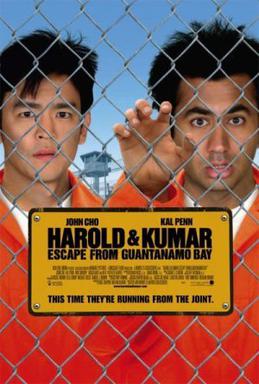
To tell the truth, I watched the predeccesor to this film on the same day, and I loved it. Harold and Kumar Go To White Castle was a twisted journey through America, following its two likeable leads across a angry, racist and paranoid country in a funny and intelligent film which played on stereotypes and revealed that the American Dream is not Doogie Howser, it's Neil Patrick Harris.
Fresh off of this experience, I looked forward to the second instalment. In the sequel, I would see Harold and Kumar reunited just minutes after the finish of ...White Castle, boarding a flight to Amsterdam before being wrongly convicted of terrorism and yes, being thrown into Guantanamo Bay.
The sequel is basically a retread of the first, as H & K escape with ease and find themselves traipsing across the United States once again. It's no longer original, and the targets are much easier this time, as evident in one scene where the pair encounter the Ku Klux Klan. Gone too is the subtlety in intelligence, in its place blindingly obvious pieces of social satire. Still, the priority of this feature is to make me laugh, and while I did laugh consistently, I also found that the toilet humour had been turned up a notch for this instalment, and that disappointed me. If I want to hear fart jokes, I'll fart in a friend's general direction and giftwrap it with a suitable wisecrack. It's not that I don't want to hear vulgar cockmeat sandwich jokes in these comedies, it's because I don't need to. I want a little bite to my humour, and this is what the first film gave me. Sadly, there's a lot less bite present in ...Guantanamo Bay, a film that assumes whatever toilet humour is thrown at the wall will inevitably stick.
There are some brilliant moments that I can't deny the film, most evident in the welcome return of Neil Patrick Harris for a few perfect scenes, and the addition of Rob Corddry as a Homeland Security Agent that had one hilarious scene after the next, practically lifting the film to another level of enjoyment and upstaging even Harold and Kumar themselves.
Of course, one of my most hated cliches in American film is the wedding run-in, and just when you think Harold and Kumar has capped off its ending with the best villain death ever, it rushes into the tired last shot at love that we've seen so many times before. Because I knew how these things out, I chose to switch off during this segment and reflect on my final thoughts regarding the overall film. It was a good follow-up, but ultimately hollow and creatively stagnant compared to its predecessor. Even as a retread, it did have its great moments and does earn rewatchability. It's just a shame that Harold and Kumar were once looking for acceptance in the white world of White Castle, and it seems so less interesting now they're looking for love.
**1/2
Art and Entertainment
When discussing film with other cinephiles, I find there are various types of people with differing taste in film, to the point where one may pour scorn on a film that others hold in high regard, and vice versa. Sometimes, these tastes come to blows, and it is particuarly between those who prefer their film to simply entertain, against those that believe film cannot serve as entertainment, but purely for artistic purposes.
These art-film lovers may hate for example, Spielberg, because his movies aim for an audience reaction through emotional manipulation. His oversentimentality guides the audience into an intended feeling, rather than inviting stimulating thought. On the other hand, you have French New Wave filmmaker such as Jean-Luc Godard, whose films are statements, at their core intellectual and without any emotional bond to the audience. Which is the right philosophy?
I'm going to provide you with the definitive answer here: neither. Those in the school of thought that only art films have reason to exist are deluding themselves. Entertainment in film has as much right to exist as art. It is part of the art, with different aims, none of them inherently "wrong" in the bigger picture of the cinema. Take for instance, the Lumiere Brothers. When they displayed their actualities at the end of the 19th century, they were shown in the Cinema of Attractions. Yes, they were slices of real life capture on film, but their intention was to manipulate the audience into a state of shock and awe. Entertainment has been a focus of film since its inception, and it will continue to be.
Just as an art film should be judged on how well it succeeds in conveying its message through the techniques of the medium, so too should a Hollywood movie be judged on how well it entertains its audience through the same techniques. Every film should be looked at in terms of how well it reaches its target, or how badly it falls short of it.
Alien is designed to entertain, frighten and shock its audience through its careful use of suspense and mystery of the unknown in a claustrophobic setting. It delivers on these prerequisites. In the same manner, Blow Up is designed to provide an intellectual thought on the nature of reality, and the perception of reality. Again, it works. You should in no way accuse Alien of being worthless because it isn't what you want it to be, because it is essentially entertainment, as if that's a bad thing. You should in no way accuse Blow Up of being worthless because it doesn't entertain you. These are two different movies, both with two very different goals. They use the medium of film to reach that goal, with great aplomb. Although that is not to say entertainment cannot be intelligent, or art cannot be entertaining - far from it.
People say I am harsh on mainstream film. I'm not, but there is a lot of absolutely terrible mainstream film (that the majority of audiences are so willing to accept) and so little of my time to waste. Just as there is poor art film, there are rubbish entertainment movies, and we must discern between the good and bad on the basis of their cinematic qualities. I judge my entertainment on its own merits. If it's a horror, it should scare me. If it's a comedy, I expect to laugh.
There is nevertheless a great hypocrisy in those that question my distaste for various Hollywood movies, in that those same people have never given an art film the time of day. Those that ignore the "art film" are just as ignorant as the snobs that snub the entertainment aspect of the medium. Perhaps those people are to blame for the advent of the snobs, who could well exist as a form of backlash against the ignorance of the general public.
In answer to the big question, I will remain adamant that neither philosophy is correct, so if you are really a true fan, get on board and watch all the films you can. I believe that if you simply watch art movies, you are betraying your true self. If you simply watch entertainment movies, you are not experiencing cinema to its fullest extent. That is as snobbish as I will get. All I can say to those that are already pidgeonholed, is to simply branch out and watch more movies.
If a man has a Top Movies list comprised of American films made in the last ten years, I sense he has only scratched the surface. If a man has a Top Movies list comprised of only films no one has heard of outside the mainstream, I sense he is not telling the truth. If a man has the best of both worlds in his Top Movies list, I see a true lover of cinema.
These art-film lovers may hate for example, Spielberg, because his movies aim for an audience reaction through emotional manipulation. His oversentimentality guides the audience into an intended feeling, rather than inviting stimulating thought. On the other hand, you have French New Wave filmmaker such as Jean-Luc Godard, whose films are statements, at their core intellectual and without any emotional bond to the audience. Which is the right philosophy?
I'm going to provide you with the definitive answer here: neither. Those in the school of thought that only art films have reason to exist are deluding themselves. Entertainment in film has as much right to exist as art. It is part of the art, with different aims, none of them inherently "wrong" in the bigger picture of the cinema. Take for instance, the Lumiere Brothers. When they displayed their actualities at the end of the 19th century, they were shown in the Cinema of Attractions. Yes, they were slices of real life capture on film, but their intention was to manipulate the audience into a state of shock and awe. Entertainment has been a focus of film since its inception, and it will continue to be.
Just as an art film should be judged on how well it succeeds in conveying its message through the techniques of the medium, so too should a Hollywood movie be judged on how well it entertains its audience through the same techniques. Every film should be looked at in terms of how well it reaches its target, or how badly it falls short of it.
Alien is designed to entertain, frighten and shock its audience through its careful use of suspense and mystery of the unknown in a claustrophobic setting. It delivers on these prerequisites. In the same manner, Blow Up is designed to provide an intellectual thought on the nature of reality, and the perception of reality. Again, it works. You should in no way accuse Alien of being worthless because it isn't what you want it to be, because it is essentially entertainment, as if that's a bad thing. You should in no way accuse Blow Up of being worthless because it doesn't entertain you. These are two different movies, both with two very different goals. They use the medium of film to reach that goal, with great aplomb. Although that is not to say entertainment cannot be intelligent, or art cannot be entertaining - far from it.
People say I am harsh on mainstream film. I'm not, but there is a lot of absolutely terrible mainstream film (that the majority of audiences are so willing to accept) and so little of my time to waste. Just as there is poor art film, there are rubbish entertainment movies, and we must discern between the good and bad on the basis of their cinematic qualities. I judge my entertainment on its own merits. If it's a horror, it should scare me. If it's a comedy, I expect to laugh.
There is nevertheless a great hypocrisy in those that question my distaste for various Hollywood movies, in that those same people have never given an art film the time of day. Those that ignore the "art film" are just as ignorant as the snobs that snub the entertainment aspect of the medium. Perhaps those people are to blame for the advent of the snobs, who could well exist as a form of backlash against the ignorance of the general public.
In answer to the big question, I will remain adamant that neither philosophy is correct, so if you are really a true fan, get on board and watch all the films you can. I believe that if you simply watch art movies, you are betraying your true self. If you simply watch entertainment movies, you are not experiencing cinema to its fullest extent. That is as snobbish as I will get. All I can say to those that are already pidgeonholed, is to simply branch out and watch more movies.
If a man has a Top Movies list comprised of American films made in the last ten years, I sense he has only scratched the surface. If a man has a Top Movies list comprised of only films no one has heard of outside the mainstream, I sense he is not telling the truth. If a man has the best of both worlds in his Top Movies list, I see a true lover of cinema.
Funny Games U.S. (dir. Haneke, US, 2008)

A father, mother and son drive gently down the country road, playfully guessing the name and artist of the song on the radio. It's classical music, perfectly complimenting the breezy feel of a regular, happy family's embarking on an idyllic summer holiday. Then out of nowhere, the shrieks of sinister, deafening death metal blast out, drowning out all sound in and around the car. The family seem oblivious to the peril; they keep looking at each other, smiling. We're into disturbing territory.
Funny Games U.S. is a shot-for-shot remake of Michael Haneke's original foreign language film released a decade ago, the effects of it still having not quite worn off to those that saw it. I haven't seen the original, but those that I've spoken to have told me they needed to watch Disney films for a good while to get over it. Along with this intriguing reaction, and the fact that I had Haneke's very good Cache in my collection, I set off to view Funny Games U.S. at the picture house. I didn't expect to enjoy myself, nor did I intend to. The two labels to conjure up in this scenario are arthouse and torture-porn; the former doesn't have entertainment at the top of its priorities, and the latter shouldn't, but unforunately does in this day and age.
Throughout the film we watch the family settle into their holiday home, peeling potatoes and changing the battery on the phone (fun!!!!) before the arrival of two suspicious, yet charming young men who look as though they've just been for a round of golf. Things don't seem right, and soon a request for eggs turns into a bash on the skull with a golf club. Before long, the family is subjected to horrendous torture for the next 90 minutes. It is uncompromising, difficult material.
Funny Games was brought across the pond because Haneke wanted to make a statement about violence in film. While I do have some problems with his execution (I'll get to that), I can't argue with his message. Why do we delight in films such as Saw and Hostel? Why do we derive entertainment from watching people screaming, being cut in half. Here's the thing: Saw is not famed for its plot, its characters or any sort of depth. It is the Home Alone of horror movies, in which the sole attraction is for its audience to wait in anticipation for the next great trap. To sit as voyeurs whilst the next unwilling victim gets their jaw spilt open or their chest ripped off.
You're probably thinking "well, lots of movies are guilty of this", and I'd be inclined to agree with you. Tarantino uses explicit violence in his movies, and Haneke has been outspoken in pointing the finger at him in particular. However, Tarantino's films are of such great quality that there's a lot more to sink your teeth into. Amazing dialogue, great characters. Likewise, with horror films, the intention of the film is to scare me. Sweeney Todd has Grand Guignol levels of mutilation, but its praise lies mostly on its music, and stylish use of gothic black and white throughout. When it boils down to it, there are no redeeming qualities, or an overall aim to the Saw series. The scripts suck and are reliant on cheap twists, the characters are one-dimensional and the stench of money-grabbing executives is all over the franchise. The audience go to see the people maimed and killed, plain and simple. There's something not quite right with that.
What Funny Games U.S. does it subverts the torture-porn genre. It doesn't show us the violence, instead choosing to focus on the consequences. It wants us to feel the pain of the victims, every agonising second of the aftermath. Therein lies the uncomfortable moments of the film, 5-minute long stretches of a bloodied mother rising helplessly to her feet. I viewed the film as one statement, and I knew I wasn't the intended audience. This was meant for those that went into the cinema expecting something in the Saw mould, wishing to be entertained by the pain of others.
While I take Haneke's side, there is an issue with how he goes about constructing his argument. All elements of the film work fine, other than some choice dialogue from the antagonists when breaking the fourth wall. Their lines to the audience drive the condescending nature of the film to new levels, and it is fully expected that even those who tolerate the film will feel as if they are being talked down to.
I didn't enjoy Funny Games U.S., but I can't deny that it was a powerful piece of cinema, and probably my favourite film of 2008 so far, at least before Wall-E and The Dark Knight come along this week and occupy the #1 and #2 spots, whichever way round. Funny Games U.S. has little flaws depending on how you look at it. Are you the disappointed voyeur, or the wrongly patronised? And if you don't like the basic concept of Haneke talking down to you, just remember that Godard had the utmost contempt for his audience, and we all love him to bits.
I have a question. If I buy the DVD, does that make me a sadist?
***1/2
Indiana Jones and the Kingdom of the Crystal Skull (dir. Spielberg, USA, 2008)
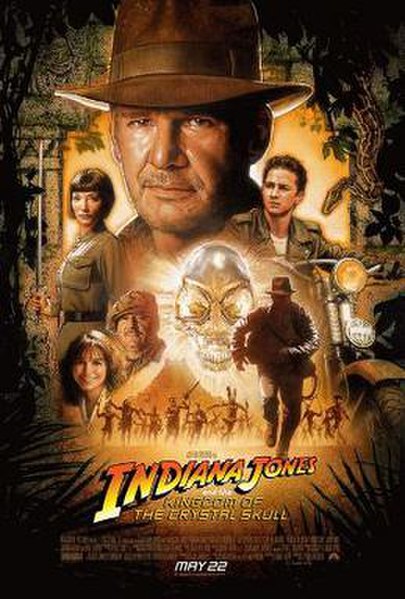
I have a great affinity toward the Indiana Jones series. The original three films served as a trilogy of pure popcorn entertainment not bogged down in carefully constructed mythology (Star Wars) or faithfulness to a source material (Lord of the Rings). When you watched an Indy adventure, you knew you were in for Harrison Ford kicking ass and taking names, running more risks than James Bond and knowing when to say when come the end of his adventure, just as his enemies always took one step further towards their doom. When I heard that a fourth was in the making, I felt assured that the franchise was still in safe hands, primarily down to the involvement of Spielberg. After witnessing the vile assortment of turd that was the Star Wars prequel trilogy, I'd become even more burned out with Lucas' Ewok-movie-producing antics. With Stevey on board for Indy IV, I hoped that George could be kept at bay.
This outing sees Indy travelling with new sidekick Mutt (Shia Labeouf) on a quest to find the crystal skull, and eventually prevent the Russians from utlising its power. Cate Blanchett plays the sexy antagonist, Irina Spalko, and Ray Winstone provides the one excruciatingly annoying performance of the piece as Mac, a fellow adventurer and all-round foolish bastard.
I like Indiana Jones and the Kingdom of the Crystal Skull, with serious reservations. Though it isn't my biggest complaint, there is the huge, looming and inevitable area of the involvement of Mr. George Lucas. You can feel his hand all over this, whether it be in the CG gophers, swinging monkey attackers, or the biggest evidence of all - the aliens. Oh, and that one isn't a spoiler, it's alluded to throughout most of the film.
There's an abundance of CGI used, despite Spielberg promising us the majority of action being comprised of traditional stunt work. Everyone has their individual problem with these action sequences, mainly because they're so unbelievably over-the-top. Well gee, go watch the hyperrealistic Raiders of the Lost Ark. Were you complaining about giant robots thwacking the crap out of each other in Transformers last year? Needless to say, the far-fetched nature of this Indy instalment didn't bother me too much. As a matter of fact, neither did the aliens - I felt it was appropriate that with the franchise adopting a look that brought itself into the 1950s, so too should the threat be updated. We're not dealing with Nazis and biblical peril anymore; this is a new world of nuclear fear, communism, greasers and B-movies. If I wasn't irked by the subjective flaws pinpointed by countless others, then what exactly was my problem with this movie? What held it back from being a great Summer 2008 blockbuster?
The script just sucked, plain and simple. I don't think David Koepp knows how to write these particular characters, even though he fancies himself a big enough Indy fan to take on the screenwriting duties in the first place. The 19 years between Crusade and Skull hinged on whether a great script could emerge, one that ticked the Lucas boxes of having aliens and Mutt. The unforunate irony being that Frank Darabont's script (which I own, haven't read) is said to be better than Koepp's, despite being rejected by Lucas - even after Ford and Spielberg expressed interest in filming it.
I can imagine Darabont's edition being a much more satisfying addition to the Indy chronicles. Koepp's script, on the other hand, aims for something else entirely. It appears to be headed for the target through its first hour, until dropping to the ground before its rushjob of a climax. Like I said, this isn't the fault of the filmmakers. Its Koepp's inability to get a grasp on the character interaction that allows Indy IV to suffer ineroxably come the final act. The first part of the film deals with the exposition involving Spalko, Mac, Mutt at el. This is heavy talk, long stretches of what some might call wearying dialogue (but not me - again, another subjective fault), before we're thrust into the maelstrom.
There's a scene in the back of a truck where the characters bicker amongst themselves over some maternal issues. The only problem being, once that's over and the car chase begins, we never hear these characters converse with one another again, throughout the rest of the film. They literally stop talking as we become subjected to scene after scene of accelerated absurdity that quickly piles up. As I said, my problem is not with the heinous nature of these action scenes, but instead with how the characters quickly have their exchanges dispensed with, and are thereby reduced to carboard figures rushing to the end credits. There isn't a moment's rest left for them to interact. There, ladies and gentlemen, is my problem with this movie.
That aside, it's all good fun. Honest. Everyone has their own problem with it, and then some things they more or less admired. Indiana Jones and the Kingdom of the Crystal Skull is not perfect; it's just perfectly acceptable...to some.
**1/2
Doomsday (dir. Marshall, UK, 2008)
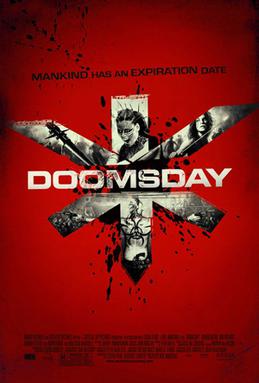
Ever experience one of those films that makes you want to laugh and cry, all at once? No, not the positive emotions - I'm talking about sheer, venomous anger watered down ever so slightly with shy, mocking laughter. A film that you tell your friends afterwards, "I came so close to walking out" whilst groaning in agony at its image still lingering in your mind, like the memory of a wetting yourself in the cue for the Peter Pan ride at Disneyland?* Doomsday is one of those films.
Neil Marshall isn't this bad, surely? I didn't think that much of The Descent, but despite my rubbish opinion it's been championed as one of the best horror movies of the decade. To its credit, it pushes all the buttons for a uncomfortable viewing experience: a tight, claustrophobic setting; near-darkness with an otherwordly predator; plus heavy breathing - which always feels naaasty. For Marshall to follow up The Descent with Doomsday, this heap of absolute trash, is a real shame for not only himself, but for our nation's cinema. If this is the best we can offer to the action genre, then God help us. Seriously.
In Doomsday, a virus has created a dystopian society in Scotland whereby everyone has sprouted a mohawk and turned into a punk, such is the requirement come the end of times. A government agent (Rhona Mitra) is sent into this hell on earth, forced to leave any semblance of a personality behind. Thus begins the adventure.
Come to think of it, she probably left her personality with Bob Hoskins, who is also a member of the cast and proves, just one year after the release of Outlaw, that everything he touches turns to shit. There's a subplot where he accidentally kills the Prime Minister and tries in vain to apologise, but it's so irrelevant to the bigger picture up north that anyone could fail to care.
Our female protagonist sets off to the danger zone, talking like a robot and asking everyone she meets if they have a cigarette. When she's not doing this, she's leading the biggest team of walking, talking cliches I have ever seen. Here's one for you: the mechanic that enters the introduction stage from under a car. There's also the guy from Hustle...
*tumbleweed*
...once the meets-and-greets are done with, it's full throttle into the heart of darkness as the film sets itself into a pace that never lets up. One could forgive easily because of its relentless energy, if it wasn't simply steamrolling through episode after episode of derivative schlock that steals unashamedly from Robin Hood: Prince of Thieves, Gladiator, Mad Max etc. The list goes on, because there's so many things Doomsday wants to be, and it can't make its mind up. It's literally like a bored child moving its way through Christmas toys.
It made me angry, though I felt determined to get my money's worth. So I started to laugh. When the guy from Hustle held his gun, standing clueless as the enemy struck a pose in slow motion before him, I chuckled. When the guy from Hustle died in slow motion from a flurry of arrows to the back a la Boromir in Lord of the Rings, I giggled. By the time a man in a gimp suit flew into a billboard and exploded, I was crying tears of laughter.
Maybe I got my money's worth? At the end of the day, I was essentially watching ten films at once. Hey, a lot of shit is surely better than just shit.
1/2*
*actually happened to me
Speed Racer (dir. Wachowskis, USA, 2008)

Why did the critics bestow upon Speed Racer such scathing reviews? Why did they cast such snooty dismissal on the only thing of worth that the Wachowski Bros. have produced since The Matrix? When I endeavoured to find the answer to this question, it lead me to straight to the answer, not to mention a point of hilarious irony. You see, the majority of critics that disliked Speed Racer gave a glowing appraisal to the mind-numbingly average Cloverfield, despite complaining that the former feature gave them... a headache... Hang on?
I felt nauseous during Cloverfield but not so during Speed Racer, but hey, that's just me. You can't account for the unpredictability of critics. Or should that read: grumpy old men critics? It seems that sumptuous visuals with an underlying warmth of heart only work in Pixar films such as Ratatouille and Finding Nemo, whereas elsewhere they are laid under the magnifying scope and heavily scrutinised. I felt fine with what Speed Racer served up to me; it was a suitably friendly tale of guarding your own integrity against the evils of selling out to the corporations, maaan. This was filtered through a familial lens as the likes of Speed himself Emile Hirsch, John Goodman, Susan Sarandon and Christina Ricci co-existed as a strong unit throughout - the only point of irritation being the obligatory annoying younger brother and his pet monkey.
It would be a shame to dwell on what didn't work for the cynical old men (or how they didn't get what they want), but what of the children? After all, this appears on the surface to be one for the
sprogs, and one would not be incorrect in that assumption. As far as youngsters go, the undeniable flaws include the runtime (well over 2 hours), repetition of techniques (broadcasters fly across the screen constantly) and the over-complicated mechanics of corporate evil. When Roger Allam - looking, sounding scarily like David Mitchell in mid-rant - burst into his third monologue in a row on where Speed Racer's interests should truly lie, I'll confess it went completely over my head.
One could count the problems on their fingers, but they wouldn't get past one hand. There's a wealth of enjoyment to be had with this one, and its flaws are easily subsided by frequent action and racing madness that literally feels like you're being raped in the eyes with skittles. The races are squeaky-clean delicious, and one fight scene in particular was bursting with such creativity and innovation that my eyes widened as if to utter the title of Pavement's third album. ;)
When I left the cinema, well, I felt like I'd watched something innocent and charming; something that took my mind off the wrongs in the world. It was a nice-looking film without a debased morality. It was a head-warmer, not a headache.
***
Subscribe to:
Posts (Atom)