Four weeks.
Four weeks since we ordered Broadband, and here it is. Finally, I can scour the internet for latest movie news, Facebook updates and pictures that no one else finds hilarious but me. It feels good to be connected to the world again, to know that I have every snippet of information at my fingertips once more. Shockingly enough, without this blog under easy access, I've found myself writing less and less. My novel has come to a grinding halt as I rework the structure, and an infuriating bout of writer's block has prevented me from cracking on with screenwriting using Final Draft.
It's time to review some films. Since I've been away, I've seen some stinkers. Yes, there were a few gems, but I'm still of the mindset that 10 months in, 2008 has been lacklustre, especially in comparision to the eclectic range of films on offer last year.
Am I watching the wrong films? Hell yeah, most definitely. Yet, now I have returned to the grand city of Leeds for the 2nd year of my degree, I find myself even closer (a five minute walk at that) to the palace of awesome that is Hyde Park Picture House.
And what's this? A film festival? In Leeds? Sweet. You'd never have guessed it, but an avid film fan, yours truly, foolishly neglected last year's event, choosing only to (wisely) attend an advance screening of No Country For Old Men. This is the year to take full advantage, to watch anything and everything. Ican'twait Ican'twait Ican'twait.
The highlight so far looks to be the Korean film The Good, The Bad and The Weird. It is a homage to all things Spaghetti Western; hopefully delivering on its promise of 'weird'. One individual I've spoken to claims it to be superior to Leone's genre-defining classic The Good, The Bad and The Ugly. Extreme hyperbole perhaps, though I shall have to see for myself.
Reliving Stalker on the big screen, accompanied by new doc Meeting Andrei Tarkovsky, is another prospect worth salivating over. Watching The Sacrifice earlier today, I remembered just how amazing ol' Tark was, how each of his films were masterpieces in their own right. Hopefully he can enrich my love of his films further at this very festival.
4th-16th November. If you're in the Leeds area, go for it!
Friday, 17 October 2008

Wednesday, 3 September 2008
Coming Up...
I've got a lot to get through, when I finally bring myself to it. I'm almost ready to compile my Best of 2007 list, with just a few more films from last year to view. I am fairly confident that I've seen the worst that 2007 had to offer, and in the knowledge that I won't willingly allow myself to sit through a film from last year that I know will be utter crap, I have concluded that the time is now to start the prelude to my Best Of list. That is, the Worst Movies of 2007.
There's also four more 2008 flicks to review, yet I feel that the focus of this blog is a little off. Why am I touching on just the films of this year? That was the aim when I first started, but it has begun to feel unsatisfying, the preoccupation of my cinematic thoughts on contemporary garbage like Doomsday and Hancock. I want to write about Chaplin, Cassavetes, Fellini and Bergman.
Hollywood is in a bad place, at the point of no return. Every year we are bombarded with adaptations, remakes and comic book movies. Originality is well and truly dead. I have discovered that there are at least 30 remakes of old horror movies in the pipeline. The most offensive part of this, the fact that all gore will be removed for the sake of a 'safe' PG-13 rating, all in the name of easy profit. Then you have films like Epic Movie chewing up the receipts at #1 in the box-office, signifying a collective all-time low in the IQ of humanity.
This blog needs spicing up. Maybe I should give a weekly film recommendation; I watch quite an ungodly amount of classic, foreign and arthouse films, so why shouldn't I write about these, spread the good word? Or perhaps an artful expansion will help, possibly an album recommendation? All I know is if I keep documenting the 'film of the week', there will be no joy in my writing.
And on that note, Bottom 25 coming soon. *Sigh*
There's also four more 2008 flicks to review, yet I feel that the focus of this blog is a little off. Why am I touching on just the films of this year? That was the aim when I first started, but it has begun to feel unsatisfying, the preoccupation of my cinematic thoughts on contemporary garbage like Doomsday and Hancock. I want to write about Chaplin, Cassavetes, Fellini and Bergman.
Hollywood is in a bad place, at the point of no return. Every year we are bombarded with adaptations, remakes and comic book movies. Originality is well and truly dead. I have discovered that there are at least 30 remakes of old horror movies in the pipeline. The most offensive part of this, the fact that all gore will be removed for the sake of a 'safe' PG-13 rating, all in the name of easy profit. Then you have films like Epic Movie chewing up the receipts at #1 in the box-office, signifying a collective all-time low in the IQ of humanity.
This blog needs spicing up. Maybe I should give a weekly film recommendation; I watch quite an ungodly amount of classic, foreign and arthouse films, so why shouldn't I write about these, spread the good word? Or perhaps an artful expansion will help, possibly an album recommendation? All I know is if I keep documenting the 'film of the week', there will be no joy in my writing.
And on that note, Bottom 25 coming soon. *Sigh*
Monday, 28 July 2008
The Dark Knight (dir. Nolan, USA, 2008)

After seeing The Dark Knight, I told a friend that having recently wrote 13 paragraphs on the disappointing The Incredible Hulk, I would need to give the latest Batman entry its just deserves. I aim to write a no holds-barred review of The Dark Knight, and in order to delve fully into its themes and plot points, the spoiler warning must be turned up to full. Before you read any other further, I'm warning you now that I will go right up to the end of the film, therefore spoilers are here, there and everywhere. Honestly though, you should have seen The Dark Knight by now. If not, what is wrong with you? March down to your nearest cinema and correct this immediately.
The logical place to start with The Dark Knight would be the gargantuan levels of hype leading up to its release. The aggressive advertising campaign started this time last year, with internet updates that seemed almost weekly, filled with cryptic hints and fun activities to rile up the fanboys and enlighten those desperate for tidbits on what to expect from the new film. In December, the opening bank heist sequence was shown in US cinemas before the IMAX version of I Am Legend (there's no way anyone would put me in an IMAX room with that hunk of shit - I Am Legend, not the bank scene); in January, the death of Heath Ledger sent a shockwave through the film industry. The intrigue and anticipation snowballed into unbearable excitement, and when The Dark Knight arrived in cinemas on 18th July 2008, it made over $65m in its first night. After 10 days, it had made almost $350m worldwide.
No Batman incarnation before Nolan, bar the Animated Series and its respective movies, had fully satisfied me as lifelong Batfan. I'm one of those rare types that can't sit through the '89 version; I find it fairly dull, and Jack Nicholson is merely playing himself yet again, albeit wearing clown makeup. Mark Hamill was always my favourite Joker up till now.
Batman Returns I preferred, because Burton utilised two interesting villains in Catwoman and The Penguin, as well as turning up the darkness that the first one had shunned in favour of Prince parades. Not only did we see a lot more of Keaton's Batman, but we felt a little more thematic worth in the proceedings, with talk of freaks and outcasts outlining the general gist of the film. It was much more entertaining than the film that preceeded it, but it also felt very cartoonish. From a comparison of the two, I knew that I wanted my Batman dark and gritty, but firmly rooted in reality.

The less said about the Schumacher incarnations, the better. All I need do is mention the Bat-credit card and the Bat-nipples to highlight how repulsive these films were. Two-Face is rightfully shown in The Dark Knight as a tragic character, but in Batman Forever he floats around cackling like any other generic headcase. Batman and Robin was even worse, the only points it gains coming from the colourful set design. With all these near-misses and failures of Batman mythology coming and going, I stood by Mask of the Phantasm as my favourite Caped Crusader film. Animated it may have been, but it knew its source material.
What to say of Batman Begins? It has a very special place in my heart, the first film that I attended a midnight premiere of, and the first live-action Batman to get it right. On its first viewing I emerged elated, but on a recent rewatch I found that it wasn't quite as awesome as I remembered. It was still a great origin story, perhaps the best superhero origin story so far, but it had its undeniable flaws. The first half moved at such a frenzied fast pace. The fight scenes weren't shot particularly well. Katie Holmes can not act. At all.
For the most part, The Dark Knight corrects each of these flaws. Even taking place in the same universe as Batman Begins, it manages to feel like a new type of movie, one higher in prestige. To say it is not just a superhero movie would be unfairly attacking an entertaining genre. Instead, it transcends the genre; for it is not just a superhero film, but a crime drama, an ensemble piece, a character study. It is about superheroes in more ways than one. In its complexity and political musings, The Dark Knight shows up Batman Begins as a vastly inferior film. Thus, it is better to view Begins as a prequel to the main event, for it set up Batman's crusade against crime. The Dark Knight examines the ramifications of this decision, it looks closely at the existence of Batman in a fictional, but very real city. It is about Batman.
The Dark Knight's plot could easily have been summed up a year ago as the ultimate showdown between Batman and his longtime nemesis, The Joker. It is still very much a film about the two opposites coming to blows, but at its heart, it follows the tragic arc of Harvey Dent, aka Two Face. Batman, Harvey Dent and James Gordon form a trifecta to stand against the unstoppable force of The Joker, who is hellbent on the destruction of Gotham. He is not concerned with money, only wishing to 'watch the world burn'. At this stage, Bruce Wayne has found in Harvey Dent a force for good in Gotham City; a man who plays by the rules and could suitable take up the mantle of enforcer in Batman's place. As the film progresses, we see The Joker test Batman, Dent, Gordon and even the citizens of Gotham, pushing them to their moral limits.

In terms of the fast pace of Batman Begins, The Dark Knight doesn't change this, rather opting to use the swiftness to its own advantage. With Begins, there was a lot to fit in, and so little time, resulting in events that should have been fleshed out feeling rushed instead. In The Dark Knight, there is a sense of impending terror that comes packaged with the presence of The Joker. Leger's performance presses the protagonists to their limit, forcing everyone to be constantly alert. With this urgency comes a requirement for such a fast pace; there is no origin to brush aside here, once the film begins we are thrown into a saga that never lets up.
The action has improved. No, I'm not talking about the vehicular carnage we are treated around the halfway mark. That set-piece is superbly staged and without use of CGI, is all the more impressive. I refer to the incoherent fight scenes of Batman Begins, improved upon in The Dark Knight with less cuts and a little more room to breathe. They're still not perfect, but they will do nicely.
Last but not least, Katie Holmes. While switching actresses between films does seem like an unfortunate distraction, it was entirely necessary in this case. Katie Holmes showed no skill or charisma in Batman Begins, delivering lines with little zest or conviction. She is replaced in the new instalment by Maggie Gylenhaal, who is a damn sight better and making us believe. She isn't the most attractive actress around, but she fits the established look of Rachel Dawes and is proficient enough to infuse the character with some much needed acting ability.
The Dark Knight does well to work upon the flaws of its prequel, but what of its own flaws? I'm not talking about the runtime, which I thought was just right, and will refer to later. I'm talking about the camerawork. Sure, Chicago looks pretty at night. The visual style of the film is excellent, full of blues and blacks to underline the gritty realism. The problem is that Nolan doesn't move the camera in any creative, interesting fashion. His camerawork is so average, which is a pity because his storytelling is top notch and could do with some innovative movement of the lens to compliment the narrative.

Cameras aside, let's talk performances, and evidently the most talked about performance of the entire film. Heath Ledger's Joker is the best incarnation of the character to date, a force so evil yet so attractive that we aren't sure whether to love or hate him. His presence is so powerful that even when he's not onscreen, we know that he could be anywhere, could jump out any time. Such is the magnetism of his portrayal that even when he isn't there, he is most definitely there.
He refers to himself as a dog chasing a car, not sure what to do with it once he gets his paws on it. The dog metaphors are continued throughout the film...The Joker sticks his head out of the window of a speeding cop car to feel the breeze. He's even guarded by a pack of dogs in the climactic fight scene, and when Batman finally has him in his grasp, its no surprise that he literally ends up on a leash. How else do you stop a wild dog?
Ledger is not just playing The Joker. He is The Joker. The character is given a tic of smacking his lips that is so effective, a constantly-changing origin story that refuses to ground the character with a human explanation, instead allowing him to exist as an unstoppable ball of anarchic energy. Every line of dialogue is psychologically pressing, delivered with the utmost menace. It is the type of role that the actor disappears into, becomes the character. It is why Ledger does indeed deserve the hype, praise, and a Best Supporting Actor Oscar nomination.

Yet with all the talk of Heath Ledger, it is unfair that others are so easily overlooked. One such individual is Gary Oldman, who really comes into his own in this instalment with a meatier role than the introductory phase he assumed in Batman Begins. However, one big surprise was Aarron Eckhart as Harvey Dent/Two-Face. Having seen Eckhart in Thank You For Smoking, and advertisements for Meet Bill and No Reservations, I had only been given glimpses of the actor in comedy roles, and I feared that was how I'd picture him in The Dark Knight. I had no need to worry, because Eckhart gives an incredibly strong, believable performance as both sides of the Dent persona. He and the filmmakers handled the character and look of Two-Face in such a satisfying fashion, that I'd be welcome for a return in the third film.
Being an ensemble piece, it is easy to lose the Batman in his own universe. True, Ledger's Joker does effectively outshine Bale at his own game, and the presence of so many key players does bring our main protagonist down to an equal playing field to the rest of his co-stars. However, that is not say this film is not about Batman. At its core, it both supports and questions Batman's very existence. Much like The Joker, even when Batman is offscreen, his presence is still felt in the narrative construct of the film. We are seeing a development in the character, far removed by the end of the film from the hero we saw saving Gotham in Batman Begins.
The development of Bruce Wayne/Batman started out as revenge against the criminal underworld. When Carmine Falcone told Wayne that he didn't understand anything, the billionaire made it his aim to travel far east in an effort to delve into the criminal mind. Here, he winessed a brand of justice he refused to acknowledge, and this spilled over into Gotham City whereby Ra's Al Ghul was dealt an ass-whooping of a lifetime onboard a Monorail train. In Batman Begins we saw poverty lead to criminality through the catalyst of Carmine Falcone and his crime empire. By the end of the film, Batman has made himself known amongst those criminals, and the Joker card revealed at the end indicates further escalation. It is this escalation that is examined in The Dark Knight, the ramifications of Batman's war on crime.

This is evident in one of the early scenes in which Batman takes down Scarecrow and his thugs. The whole thing says 'routine', as if these two have been going around in the same circle for months following the events of the first film. Then the 'Friends of Batman' show up in their poorly constructed Batsuits, ultimately asking the Caped Crusader 'what makes you so different?', to which he replies, 'I don't wear hockey pads'. But what does make him so differennt, what justifies the existence of Batman that he can operate as a vigilante?
The escalation occurs on both sides of the law. The 'Friends of Batman' exist as an imitation of the Batman, putting themselves in danger through their vigilantism. Was this what Batman intended when he said he wanted to shake people out of their apathy? Likewise, the underworld has now turned to 'a new class of criminal' in the Joker, because like Batman, he is a freak that crosses the conventional boundaries of cops v. robbers. Gone are the Scarecrows of yesterday, in come the clowns.

Are we therefore to assume that Batman, as a symbol, is inherently dangerous to the city he protects? Has he brought more harm than good? It is possible that Batman is a representation of George W. Bush, one that operates outside of the acceptable rules. In The Dark Knight we see Batman:
- Extract a criminal from another country and bring him back to the USA for detainment.
- Perform a metaphor for extraordinary rendition on The Joker inside a prison cell.
- Construct a lie to the citizens of Gotham, positing the false public image that Harvey Dent was a saint up to his death.
- Use a BatSonar to track down The Joker, a wrong practice that infringes on the civil rights of Gotham City.
Consider this: the war in Iraq has created more terrorists since it began. This no doubt equates to the effect Batman has had in creating the Joker, and the actions it drives each man towards as a result. The poster says 'welcome to a world without rules'; in this new world that Batman has created, manifested in the microcosm of Gotham City, do the ends justify the means? Is technology such as the BatSonar acceptable to use until The Joker is destroyed, just as if the same device could only be put to rest when the terrorists of our real world are gone completely?

Because Batman could be seen as a metaphor for Bush, or right-wing ethics in general (superheroes are generally perceived as right-wing creations anyway), does this make the film anti-Batman, or Pro-NeoCon? Let's examine the ending. Harvey Dent, driven to revenge as the villainous Two-Face (yet still existing under his own rules, note the coin), is 'killed' in a fall. For 'the greater good', Batman and Gordon lie to the people, telling them that it was Batman who murdered the five cops, not Dent. As Batman is chased, Dent's memory lives on as The White Knight, because it is safer for the people to believe in him as the image the media presented him, rather than the darkness that was surfacing underneath. Batman is not safe to belive in, everything he represents and inspires leads the film's conclusion to affirm the title: The Dark Knight.
Yet because Batman is running away as the credits appear, does this make the film anti-Batman? It does suggest the negative effect of his symbol, and the justification for his existence, but is this stemming from the narrative? Gordon tell us that he will forever be 'the silent guardian', implying that he is a force for good, albeit one that Gotham can not comprehend. Essentially, it is the people of Gotham that are anti-Batman, not the film itself. So is the film pro-Bush? In thinking this, I stumbled across a right-wing US news article last night championing Batman as their new Jack Bauer in a rather sensationalist article. I'd prefer to think that the film is asking questions of its audience, to invite them in speculation as to whether the ends do justify the means; whether Batman is right to run at the conclusion, or if he is truly the hero Gotham needs. To determine which way Nolan leans, we will have to see the direction he takes in the third instalment.
If Nolan is to make a third one (which isn't confirmed), one can safely assume that it will concern the redemption of Batman. Thematically, 'the night is darkest before the dawn', and this film was The Dark Knight. Maybe the third and final film in Nolan's series will examine the re-emergence of Batman as a widely accepted force for good in Gotham City.

If I was in Nolan's shoes, I'd have cast Jeremy Davies as The Riddler (pictured above) in the third instalment. In The Dark Knight, the criminals turned towards someone they couldn't trust. In Batman 3, the cops, and the people, should turn towards someone they can't trust. The Riddler should occupy the vacuum left by Harvey Dent, and be given the unenviable task in tracking down Batman, all the while having a villainous undercurrent. This would play with the issue of media image and public perception, and would be thematically boosted by the return of Harvey Dent, proving that all is not what it seems on the surface. With Batman too, all is not what it seems on the surface, and perhaps the public have wrongly judged their 'silent guardian'.
(As an aside, I don't belive Harvey Dent is dead. The ending was very ambiguous, and Eckhart has since stated that he'd love to work with Bale and Nolan again. I'd gladly welcome the return of Two Face)
Already I have typed more than I did for The Incredible Hulk, this time with praise. That is because The Dark Knight invites discussion, provides more questions than answers like every good film should. As I said in my review of The Incredible Hulk, all that you see in Leterrier's trailer is what you get. The trailer for The Dark Knight is really only half the film, and I found that even with all the articles and clips I'd viewed of the film prior to seeing it in IMAX, I was still hit on the head with so many great suprises. On the surface, The Dark Knight is a perfect Batman film, a perfect representation of Batman and his two best villains, The Joker and Two-Face. It is the best superhero film ever made, as well as an excellent ensemble crime piece. Underneath, it is rich with themes of modern society, terror and the people who lead us in the battles against evil.
In transcending the genre of the superhero movie, Nolan has provided the definitive statement. Forget the paper-thin issues of 'power and responsibility' from Spider-Man, or 'mutant equality' from X-Men. With The Dark Knight, we finally have a realistic examination of what it means to have a superhero in our society, and the ramifications of their actions. This is a series that delivers on developing its character throughout their journey. Nolan has achieved a truthful realism over comic-film helmers only hope to achieve; he has raised the bar, provided the definitive statement and rendered all future superhero films redundant.

The Dark Knight is 2hrs 32mins in length, but not once did I feel bored, because it is such an intense thrillride full of colourful characters and thoughtful premises. Not one scene did I think could have been chopped, because they all serve their purpose in reinforcing the issues that the film deals with. I urge all of you to contribute to the box office for this film, to help it overtake Titanic at least in the US domestic gross revenue (this is seeming very likely now), and if at all possible, go see it in IMAX. It is a glorious sight; 20 minutes are shot in IMAX format, but you also benefit from hearing the excellent film score at its loudest volume.
My expectations were superseded, my doubts crushed. The Dark Knight was for me, the best Batman film and the best superhero film. Hey, it even overtook A History of Violence as my favourite comic book film. It made Batman Begins seem like the prequel, because it actually dealt with Batman's presence in Gotham, how his war against crime would actually work, if it did at all. For a piece of Hollywood, it should be praised for being so daring, where other action films settle too easily for brawn over brain.
This franchise just recieved its very own The Empire Strikes Back.
****
Friday, 25 July 2008
The Happening (dir. Shyamalan, USA, 2008)

Even before Shyamalan's latest thriller entered the nation's multiplexes, I suspected prematurely that he was in for another critical mauling. Lady in the Water had offended many film reviewers across the globe for Bob Balaban's portrayal of a cold, snobbish film critic that met his end at the hands (or paws) of a vicious wolf-thing...or whatever that was.
It isn't rocket science to conlude that Shyamalan's inclusion of this character served as a response to the negative reception of his previous film, 2004's The Village. Furthermore, Mr. M Night has now seen himself subjected to the critics' own response. They would have taken the insult of Balaban's character to heart, perceived Lady in the Water to be self-aggrandising drivel and duly spewed hatred on The Happening. Is this the correct assumption, or is the film truly deserved of its widespread bashing?
To clear things up, yes, The Happening does have the absurd premise you've been hearing about. I won't spoil the ins and outs of the great peril, but I will explain that, as the posters and trailers suggest, people across the USA are mysteriously offing themselves. Mark Wahlberg and Zooey Deschanel star as a married couple that run like 'fraidy cats across the country from whatever is causing this insanity.
Shyamalan's track record doesn't wow me so much as it encourages me to scour the rental store for something a little more invigorating. As much as I admire the combined heart and thrills on offer in The Sixth Sense, I don't think it has aged terribly well. This could be my fault, having known the twist before I saw the actual film, but compared to what else was on offer in 1999 and what has been produced ever since, it doesn't seem like such a great achievement 9 years on. Cinema has moved on, we've experienced lazy twists over and over to the point where we find it unbearable not to have all cards on the table, and stay there. I'm over plot twists, I don't want the rug pulled out from me anymore. Especially when you're using the twist as an excuse to 'wow' your audience out of any critique that centres on your lazy writing. I'm not digging at Shyamalan here, oh no. This one goes out to the Saw franchise, yet again.
For every M Night Shyamalan film that surfaced following The Sixth Sense, audiences soon realised his storytelling mannerisms and started in earnest to look for the plot twist in every one of his films. He became synonymous with the device. That is, until Lady in the Water came along.
Here comes the shocker: I like Lady in the Water.
Hell, I really like Lady in the Water. Sure, there is Balaban's polarising role. And yes, Shyamalan does cast himself as the saviour of the universe. And not to mention, none of the mythos conjured up in the film make any sense whatsoever.
So what? Film audiences believed in E.T. when he ran into Elliott whatsisname all those years ago. The key thing about Lady in the Water is its cast of characters get on board to help the narf return home, regardless of all the gibberish they're hearing. They're willing to believe, and the film critic is so boxed in inside his own, short-sighted world that he ultimately meets his demise at the hands of the very creatures he refused to acknowledge. Shyamalan only asked us to let go for 90 minutes and enjoy an original fable, however convoluted it appeared to be. Not to mention, there was beautiful shots here and there.
Having enjoyed Lady in the Water and not taking it as a personal insult like the rest of the world's population, I expected much of the same situation come the release of The Happening. Critics would despise, and I would look to appreciate some of the finer aspects of the film. At least, that's what I thought.
I was so wrong. The Happening is an awful, awful film. It isn't even a film; it is a guide to how not to shoot a film. Technically, aesthetically, it's a total failure.
The first thing you realise, about 45 minutes into the film, is that Shyamalan is attempting to pay tribute to Alfred Hitchcock's The Birds, with his own spin on nature turning against Earth's human occupants. If M Night fancies himself as the next Hitchcock, he needs to start mustering up a sense of dread to start proceedings. Nothing in The Happening screams immediate danger, making it seem more like a well-intentioned but truly hideous B-movie, rather than a Hitchcock imitation. Without the notion that this 'catastrophe' was in any way threatening to the protagonists, the film becomes no better than a generic American horror directed by any other generic American horror filmmaker. Shyamalan isn't setting himself apart from the bunch here; he's putting them on a pedestal by lowering his previous reputation as a talented filmmaker.
The direction, editing and composition is a disappointment. Characters are shown in the same room, only in separate, distant cuts that indicate they're not in the same vicinity as one another at all. People act in the most unconvincing manner; walking away from their escape vehicle in order to watch another vehicle drive off. Do real people do that, especially in times of extreme danger? These people also have a habit of talking as they walk, taking a few steps, and then stopping to face each other to say something important, before continuing their walk. Totally inane, and yet again, reduces the seriousness of the material.
The biggest crime of all is undoubtedly the sheer number of closeup reaction shots framed on Mark Wahlberg's face. Every other shot in this film is of his constipated face making ridiculous statements such as 'Central Park, that's weird', for everyone around him to then ignore. If I counted on my fingers that amount of times the camera jumps onto Marky Mark's face, I'd need about 37 arms.
I am afraid this has turned into a rant. Still, for all the scorn I pour onto this gigantic disappointment, I can't help but remember all the smiles it put on my face. Yes, The Happening is saved from the lowest score available by being one of those films. It has fallen straight into the 'so bad it's funny' archive. How could I forget the old lady who was overly protective of her lemon juice? Or Marky Mark conversing with a plastic plant? Or this gem of dialogue:
"Kids."
"Yeah?"
"...nothing."
The Happening made me laugh, but I am not to judge it as a comedy. The poster and the trailer offered me something else entirely, and it was not delivered. On its own intentions, The Happening fails miserably and proves that this time around, yes, M Night Shyamalan produced a real stinker.
*
Tuesday, 22 July 2008
The Incredible Hulk (dir. Leterrier, USA, 2008)

Just when you thought there wasn't anywhere left for the superhero genre to go, Marvel ups the ante. The Incredible Hulk is, like many other franchise first acts, packaged with hints of what is yet to come, mostly concerning the future villains we can expect to see. Only on top of this, Marvel has decided to include a Tony Stark cameo in the final scene, foreshadowing the Avengers Initiative which is no longer a secret and will definitely lead to a feature film revolving around the team of heroes in the Summer of 2011. This is perhaps more of a big deal than most care to let on. Marvel are taking their heroes in a new direction, all geared towards one mammoth team-up at the end of the tunnel. Thor, Iron Man, Captain America and The Incredible Hulk are each destined to collide in The Avengers. The interconnecting grand scheme of this can only mean that each film from here on in will have its default "tie-in scene", and soon enough the Marvel films will reflect the universe of their comics, each feature dependent on an understanding of its predecessors to complete the jigsaw. Working in their own right, but part of a much bigger picture. Myself, I'm not sure whether Marvel should pin the hopes of all their big names on one final feature in The Avengers, but provided they pull it off with a great director and a worthy script to cap off all this plotting, then maybe it was always a good idea. The big issue, however, will always rear its head when watching a film series such as The Incredible Hulk, or Iron Man. Are these stories existing within their own franchise, or are they subservient to The Avengers big idea? Is what we see going to tie itself up inside its own context, or spiral out into the rest of the universe, rendering all films within Marvel's library insignificant when viewed as individual pieces of film?
This is what comes to mind when the end credits of The Incredible Hulk roll up. Having just witnessed Tony Stark explain his Initiative to General Ross, it would be fair game to immediately assume that The Incredible Hulk itself was merely a prologue of things to come. One can surmise that with Hulk's large presence, he will most certainly have a large role to play in The Avengers film, and by which time this entry into the Marvel canon will be forgotten as just another small starting point that led to greater things. It could be destined to fall alongside The Punishers and Ghost Riders of their universe, rather than with the esteemed Spider-Man and X-Men series.
To say this would assume that The Incredible Hulk is, essentially, a forgettable venture into the world of Bruce Banner and company. Evidence to support this claim would centre around the routine structure of the film; how everything seems all so familiar to Iron Man, with the way in which Tim Roth's villain mopes around for two thirds before 'powering up' in the final act; the obligatory 'love interest' that obviously can't find bliss with our protagonist until Film #3 in the trilogy...because everything has to be a trilogy these days.
It's the idea of the trilogy or the 'bigger picture', obviously geared towards turning a huge profit, that sucks the excitement out of these summer blockbusters. With the timeframe firmly in place, we're subjected to the 'origin story', the 'darker sequel' and, as proven so far, the 'disappointing threequel'.
With The Incredible Hulk, director Louis Letterier has opted for the dark tone right away, so as to mirror the inner torment of Bruce Banner. It's not easy being the Hulk, as Bruce finds yet again in this reboot (as far away from the introspection of Ang Lee's 2003 art-film Hulk as it's likely to get), travelling across the globe searching desperately for an antidote that will cure him of his aggressive, green alter-ego. Aiding him in this quest are Liv Tyler as Betty Ross and Tim Blake Nelson as Dr. Samuel Stern - hellooo, future villain. Fighting against him are William Hurt's General Ross, Tim Roth's Emil Blonsky and the entire US army.
Reports that Norton's script of depth and character development being cut up by the studio seem to be of some truth, with Letterier more or less implying the fact by stating at a recent press conference that the director's cut DVD will include an extra 70 minutes of footage not included in the theatrical cut. That's a lot of film. You can tell it's missing too, as scenes of character interaction become abruptly cut short in the midst of a conversation as we're thrown into yet another shot of Tim Roth sweating. The film moves at such a breakneck pace, that it's more than easy to see what Marvel were aiming for here. Dissatisfied with Ang Lee's entry in 2003, they felt the need to scrap what really makes the Hulk character interesting and in place of introspection, they turned up the clobbering.
The fight sequences are the best part, with a showdown between Hulk and an entire squadron of soliders and tanks on a college campus being the overall highlight of the film. The ending fight with Roth's beefed-up Abomination isn't too shabby either, and more than makes up for what some may have deemed an underwhelming last battle in Iron Man, earlier this year. Yet for all it dishes up to us in tank explosions and chopper drops, it lacks heavily in any form of substance. It tries its best to deliver a slight hint of exposition here and there, but you can tell that the meatier scenes have been misplaced intentionally, in favour of soulless references to what shorts Bruce should wear for his next trip outside.
The Incredible Hulk needs depth like Hayden Christensen needs a tonal range in his voicebox, because without it, the film is no different to watching two lions go at on the Discovery Channel. The trailer for the film gives a complete summary of everything that happens, right up to Hulk's confrontation with the Abomination. Watch this 3-minute clip show and you've seen all there is to experience from The Incredible Hulk, because there is little else to absorb. It is an empty shell of a film.
It's all very well hiring actors like Robert Downey Jr. and Ed Norton to lift the superhero genre above snide generalisations, but while these are inspired moves, it just isn't enough. We need an authorial voice coming through to the audience. Take for example Christopher Nolan's Batman series. In The Dark Knight, which I have yet to see, he has not settled for your temporary comic book summer distraction; instead he has, as the reviews are informing me, crafted a crime epic, an ensemble piece that transcends the genre of superhero movies. I have seen so many trailers and clips from The Dark Knight in the leadup to its release, and I still don't know what to expect. That is the magic. It is said to be original and unpredictable...all of the things The Incredible Hulk is not.
The Nolan Batman series is also heavily character-driven, they are in fact the first Batman films to really delve deep into what makes the world of Bruce Wayne and Batman so interesting. Nolan has raised the bar for the genre that he's almost skyrocketed out of it, and everyone else needs to catch up. The Incredible Hulk needs to be character-driven, and not feel like an extended Peter Griffin/Chicken fight from Family Guy. I want to know Emil Blonsky's motivations, why he feels the need to become who he is, what got him to that point. I want to know how General Ross really ticks. I want justification for Betty Ross, other than the studio-forced female desire she so plainly assumes.
So Lee's Hulk flopped, so what? That does not call for a complete dismissal to all semblance of character development and depth in this film. This is the result of a script butchered, amongst a summer of other scripts so wrongfully thrown on the trash pile. We've seen Darabont's superior Indy IV treatment rejected in favour of a poorly written slab of noise. On top of that we've experienced the ghastly, hideous Hancock, whose script was once a piece of interesting, poignant, if perverse storytelling that would have impressed me on the big screen; instead I was fed more cliched Americanised trash. It's a shame that the same thing has happened to The Incredible Hulk, but Marvel has the opportunity to free the strangehold on their filmmakers. Give Leterrier the creative license to build something of worth, instead of harming his reputation by reducing his work to brainless shlock. Let Favreau continue the good job he's done so far; the man admires Nolan's storytelling skills and is willing to take Iron Man to new levels of greatness - give him the benefit of the doubt.
Comic books are deeper than anyone likes to give them credit for. Behind every mask is a conflicted character, but he is only permitted room to breathe when the perfect writer comes along, fleshes that character out and takes the title to new heights. I have always said that a comic character is only as good as his writer. Comic books are capable of originality, creativity and depth under the right author, I've experienced it. I want the Marvel Universe in film form to be as strong as it has shown itself to be in paper format. If Marvel truly wants to bring itself to life on the silver screen, every production must count, must have an auteur driving force and a cast that believes in their role, not as a throwaway spandex-clad superman; as a living, breathing hero.
The Incredible Hulk is passable entertainment, but it has failed on all the quotas that are set for it in the wake of 2008, with the advent of Iron Man and The Dark Knight. There is hope for the franchise to right its wrongs and provide us with something to chew on in the inevitable second and third instalments. Unfortunately, the first instalment is off on the wrong foot and will join Daredevil in the annuls of my forgotten heroes. A second missed opportunity for Bruce Banner, a huge misstep for the Hulk.
**
Monday, 21 July 2008
Batman~!
In anticipation of what is sure to be the greatest film ever created in The Dark Knight, I'm posting up my ratings for each of the previous Batman films. I'm not one to depend purely on ratings in determining my love for a film (I prefer to explain and not attribute an empty number), however, I have many reviews for recent films to write, so the entries for each of these Batman films will have to wait for another time.
Batman: Mask of the Phantasm - ****
Batman Begins - ***1/2
Batman Beyond: Return of the Joker - ***1/2
Batman Returns - ***
Batman '89 - **1/2
Batman: Mystery of the Batwoman - **1/2
Batman '66 - **1/2
Batman Forever - **
Batman: Sub-Zero - *1/2
Batman and Robin - *
Batman: Mask of the Phantasm - ****
Batman Begins - ***1/2
Batman Beyond: Return of the Joker - ***1/2
Batman Returns - ***
Batman '89 - **1/2
Batman: Mystery of the Batwoman - **1/2
Batman '66 - **1/2
Batman Forever - **
Batman: Sub-Zero - *1/2
Batman and Robin - *
Saturday, 19 July 2008
Harold & Kumar Escape from Guantanamo Bay (dir. Hurwitz/Schlossberg, US, 2008)
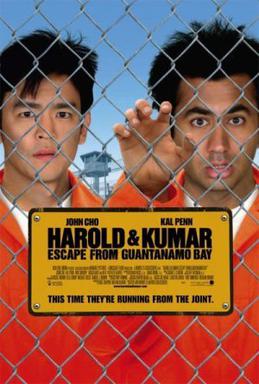
To tell the truth, I watched the predeccesor to this film on the same day, and I loved it. Harold and Kumar Go To White Castle was a twisted journey through America, following its two likeable leads across a angry, racist and paranoid country in a funny and intelligent film which played on stereotypes and revealed that the American Dream is not Doogie Howser, it's Neil Patrick Harris.
Fresh off of this experience, I looked forward to the second instalment. In the sequel, I would see Harold and Kumar reunited just minutes after the finish of ...White Castle, boarding a flight to Amsterdam before being wrongly convicted of terrorism and yes, being thrown into Guantanamo Bay.
The sequel is basically a retread of the first, as H & K escape with ease and find themselves traipsing across the United States once again. It's no longer original, and the targets are much easier this time, as evident in one scene where the pair encounter the Ku Klux Klan. Gone too is the subtlety in intelligence, in its place blindingly obvious pieces of social satire. Still, the priority of this feature is to make me laugh, and while I did laugh consistently, I also found that the toilet humour had been turned up a notch for this instalment, and that disappointed me. If I want to hear fart jokes, I'll fart in a friend's general direction and giftwrap it with a suitable wisecrack. It's not that I don't want to hear vulgar cockmeat sandwich jokes in these comedies, it's because I don't need to. I want a little bite to my humour, and this is what the first film gave me. Sadly, there's a lot less bite present in ...Guantanamo Bay, a film that assumes whatever toilet humour is thrown at the wall will inevitably stick.
There are some brilliant moments that I can't deny the film, most evident in the welcome return of Neil Patrick Harris for a few perfect scenes, and the addition of Rob Corddry as a Homeland Security Agent that had one hilarious scene after the next, practically lifting the film to another level of enjoyment and upstaging even Harold and Kumar themselves.
Of course, one of my most hated cliches in American film is the wedding run-in, and just when you think Harold and Kumar has capped off its ending with the best villain death ever, it rushes into the tired last shot at love that we've seen so many times before. Because I knew how these things out, I chose to switch off during this segment and reflect on my final thoughts regarding the overall film. It was a good follow-up, but ultimately hollow and creatively stagnant compared to its predecessor. Even as a retread, it did have its great moments and does earn rewatchability. It's just a shame that Harold and Kumar were once looking for acceptance in the white world of White Castle, and it seems so less interesting now they're looking for love.
**1/2
Subscribe to:
Posts (Atom)